

Pool areas attract mosquitoes in summer primarily because of standing water near the pool, not the pool water itself. Mosquitoes need still, shallow water to breed, and a typical backyard pool creates dozens of unintentional water pockets within a 100–300 foot radius. Clean, chlorinated, circulating pool water is actually hostile to mosquito larvae. The real problem is the perimeter: puddles on pool covers, stagnant skimmer baskets, plant saucers, and clogged gutters. Understanding why pool areas attract mosquitoes in summer is the first step toward reclaiming your backyard.
Why do mosquitoes breed near pools?
Mosquitoes breed near pools because the surrounding environment almost always contains the one thing they need: still, shallow water. A female lays 100–300 eggs in as little as half an inch of water. That is less water than what collects in a forgotten bucket after one rainstorm.
Summer heat accelerates the entire process. Larval development can complete in as little as 48 hours when temperatures rise above 70°F. That means a puddle that forms on a Monday can produce a new generation of mosquitoes by Wednesday.
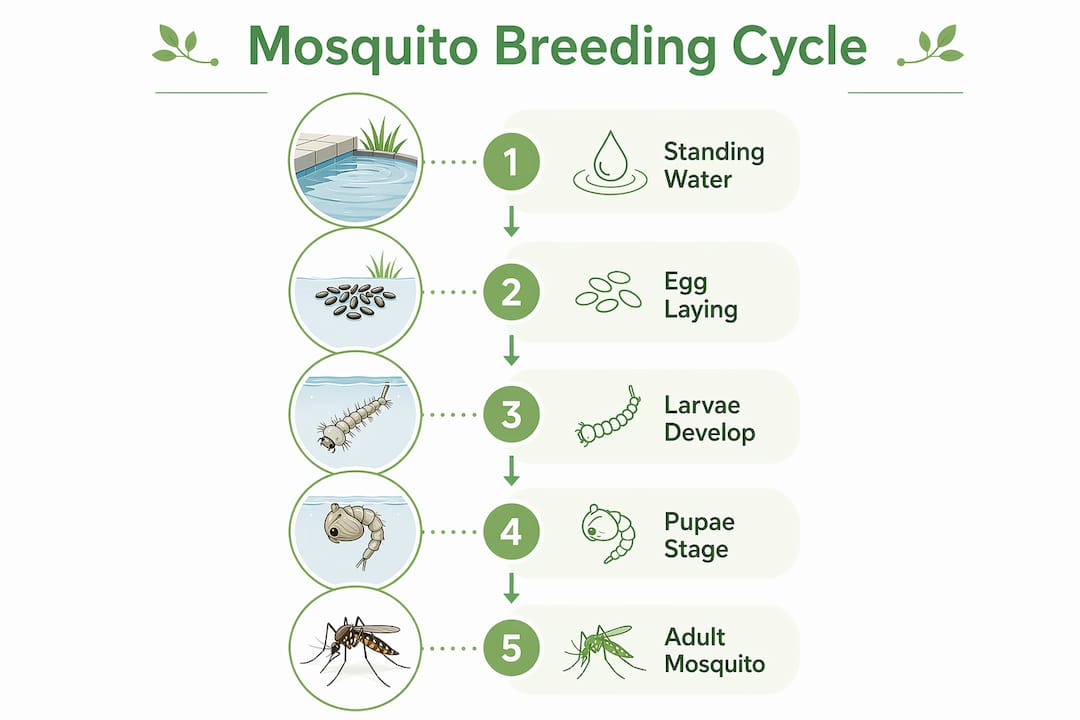
The full mosquito life cycle runs 7–10 days under normal conditions. Every stage except the adult requires undisturbed, still water. That is why movement and circulation are so effective at stopping them.
Here are the most common breeding sites found in pool areas:
- Pool covers with sagging sections that collect rainwater
- Skimmer baskets that hold stagnant water when the pump is off
- Plant saucers and decorative pots near the pool deck
- Kiddie toys, buckets, and floats left outside between uses
- Clogged gutters on pool houses or nearby structures
- Condensation drip trays under outdoor refrigerators or coolers
The table below shows how quickly mosquitoes can establish a breeding cycle in common pool-area water sources.
| Water Source | Volume Needed | Time to Larvae |
|---|---|---|
| Pool cover puddle | Less than 1 inch | 48 hours in summer heat |
| Skimmer basket | Small residual pool | 48–72 hours when pump is off |
| Plant saucer | Half an inch | 48 hours |
| Clogged gutter | Any standing water | 7–10 days |
| Kiddie toy or bucket | Half an inch | 48 hours |
Why a properly maintained pool does not attract mosquitoes
A properly maintained pool is physically incapable of supporting mosquito larvae. Active pool circulation at 40–60 gallons per minute disrupts the water surface tension that mosquitoes need to lay eggs. No still surface means no egg laying.
Chlorine does the rest. Chlorine levels between 1–3 ppm kill any larvae that do enter the water within 24–48 hours. The surface skimmer then removes floating eggs before they can hatch. Together, circulation and chlorination create a two-layer defense that mosquitoes cannot survive.
Mosquitoes do not breed in clean, chlorinated, circulating pool water. This is one of the most misunderstood facts about poolside bug problems. Homeowners who blame the pool itself are looking in the wrong place.
Pro Tip: Run your pool pump for at least 8 hours per day during summer. Continuous circulation is your single most effective defense against mosquito breeding in the pool itself.
Hidden mosquito breeding sites around pools homeowners often overlook
Mosquitoes stay within 100–300 feet of their breeding site. That means if you have mosquitoes at your pool, the source is almost certainly within your own yard. The pool is not the problem. The perimeter is.
Pool covers are the highest-risk site most homeowners ignore. Even less than 1 inch of water on a sagging cover can produce hundreds of larvae within 48 hours. Dry folds in the cover also store dormant eggs that hatch the moment water accumulates again.
Skimmer baskets are the second most overlooked site. When your pump cycles off for 12 or more hours, the basket holds a small pool of nutrient-rich, stagnant water. That is a perfect nursery, shielded from sunlight and chlorination.
Here are the hidden sites to inspect every 48 hours during mosquito season:
- Pool cover surface. Check for any sagging sections holding water. Even a small depression counts.
- Skimmer baskets. Lift the lid, empty the basket, and rinse it out. Do this daily.
- Equipment pads and catch basins. Water collects under pump housings and around filter equipment.
- Spa covers and hot tub lids. These trap moisture and condensation underneath.
- Irrigation overspray zones. Sprinkler heads that wet pavement or pool decking create moisture trails that attract mosquitoes.
- Leaking hose bibs or pool equipment. Moisture trails from leaks and condensation are attractants in their own right, separate from standing water containers.
- Decorative water features. Birdbaths, fountains, and garden ponds without aerators become breeding grounds fast.
The presence of mosquitoes near a clean pool almost always signals a hidden water source nearby, not a problem with the pool water itself. Knowing where to look cuts your inspection time in half.
How to keep your pool area mosquito-free this summer
Preventing mosquitoes around pools requires a consistent weekly routine, not a one-time fix. The goal is to eliminate every source of still water within 100 feet of your pool before larvae can mature.
Your weekly mosquito prevention checklist:
- ✅ Drain pool covers weekly. Use a submersible pump to remove standing water from sagging covers. Do not wait for it to evaporate.
- ✅ Empty skimmer baskets daily. Rinse the basket with a hose to remove organic debris that feeds larvae.
- ✅ Inspect the perimeter every 48 hours. Walk the full 100-foot radius around your pool and tip out any container holding water.
- ✅ Maintain pool chemistry. Keep chlorine at 1–3 ppm and run the pump at least 8 hours per day.
- ✅ Trim vegetation near the pool. Creating a 3–4 foot open buffer zone around the pool edge limits the shaded, humid resting places mosquitoes use during the day.
- ✅ Fix leaks immediately. Address dripping hose bibs, irrigation overspray, and condensation drip points as soon as you spot them.
- ✅ Store pool toys and equipment dry. Flip buckets, empty floats, and store kiddie toys indoors or in a dry shed between uses.
Pro Tip: Schedule your perimeter inspection at dusk. Mosquitoes are most active at that time, which makes it easier to spot where they are congregating and trace them back to their breeding source.
For poolside protection you can apply directly to your skin, natural mosquito repellents without synthetic chemicals are worth keeping in your summer rotation. Pair repellent use with your yard maintenance routine for the best results.
Landscaping choices also matter. Dense shrubs and ground cover near the pool deck hold moisture and give mosquitoes a cool, shaded place to rest between feedings. Replacing dense plantings with gravel, pavers, or open lawn within a few feet of the pool removes that daytime shelter.
For summer skin care during outdoor activities, a seasonal skin care checklist can help you protect skin that is repeatedly exposed to sun, water, and insects. Healthy, well-moisturized skin also responds better to natural repellent formulas.
Key Takeaways
Pool areas attract mosquitoes in summer because peripheral standing water near the pool creates breeding grounds, not the pool water itself, which is hostile to larvae when properly maintained.
| Point | Details |
|---|---|
| Pool water is not the source | Clean, chlorinated, circulating water kills larvae and prevents egg laying. |
| Perimeter inspection is critical | Inspect within 100 feet every 48 hours to find hidden standing water. |
| Pool covers are the top risk | Less than 1 inch of water on a cover produces hundreds of larvae in 48 hours. |
| Skimmer baskets need daily care | Empty and rinse baskets daily to eliminate stagnant water during pump-off periods. |
| Consistent routine beats one-time fixes | Weekly draining, daily skimmer checks, and proper pool chemistry stop breeding before it starts. |
What I’ve learned from watching homeowners fight the same mosquito battle every summer
Every summer, I see the same pattern. Homeowners treat their pool with extra chemicals, scrub the walls, and shock the water. The mosquitoes keep coming. The pool was never the problem.
The real culprit is almost always the pool cover left sagging with two inches of rainwater, or the skimmer basket that nobody has touched in a week. These are the spots that turn a beautiful summer evening into an itchy nightmare. They are also the easiest to fix once you know where to look.
What surprises me most is how few people realize that mosquitoes travel only 100–300 feet from where they hatched. That is a manageable radius. You do not need to treat your entire neighborhood. You need to treat your own yard, consistently, every 48 hours during peak season.
The integrated approach works. Pool chemistry plus perimeter management plus daily skimmer maintenance creates conditions where mosquitoes simply cannot establish a foothold. Skip any one of those three, and the others lose effectiveness fast.
My honest advice: start with the skimmer basket. It is the most neglected spot, the easiest to fix, and often the one producing the most larvae. Clean it every single day from june through september. You will notice the difference within a week.
— Jeffi
Jeffi’s natural protection for your poolside summer
Keeping mosquitoes out of your yard is only half the battle. When you are out there enjoying the pool, you want protection on your skin too.

Jeffi makes Non-GMO Project verified, all-natural bug bite relief and skin care products designed for exactly this kind of outdoor living. After a long day in the sun and water, your skin deserves more than just a rinse. Jeffi’s whipped body butters and sugar scrubs replenish moisture and soothe irritated skin after outdoor exposure. For full poolside coverage, explore Jeffi’s natural repellent and skin care bundles built for summer. Safe, effective, and free from synthetic chemicals.
FAQ
Why do mosquitoes swarm near pools even when the water is clean?
Mosquitoes swarm near clean pools because they are breeding in peripheral standing water, not the pool itself. Inspect pool covers, skimmer baskets, and containers within 100 feet of the pool to find the actual source.
Can mosquitoes breed in a chlorinated pool?
Mosquitoes cannot breed in a properly chlorinated, circulating pool. Chlorine at 1–3 ppm kills larvae within 24–48 hours, and water movement prevents egg laying.
How often should I check for standing water around my pool?
Check for standing water every 48 hours during mosquito season. Larvae can mature in as little as 48 hours in summer heat, so inspections every other day break the breeding cycle before adults emerge.
What is the fastest way to stop mosquito breeding near a pool?
Drain water off pool covers weekly and empty skimmer baskets daily. These two steps eliminate the most productive breeding sites in a typical pool yard.
Are natural mosquito repellents effective for poolside use?
Natural mosquito repellents work well for poolside use when applied consistently. Jeffi’s all-natural repellent formulas are Non-GMO Project verified and safe for outdoor skin exposure during summer activities.