

Body odor is the primary chemical signal that guides mosquitoes to human hosts, working through a complex blend of volatile organic compounds (VOCs) your skin releases every minute of every day. Understanding what role body odor plays in insect attraction explains why some people get bitten constantly while others walk away untouched. Your unique scent profile, shaped by genetics, skin bacteria, hormones, and diet, tells mosquitoes exactly where you are and whether you are worth landing on. The good news is that understanding this chemistry gives you real tools to enjoy the outdoors with fewer bites.
What chemicals in body odor attract mosquitoes most strongly?
Human skin emits over 1,000 distinct VOCs, and mosquitoes have evolved to detect specific ones with remarkable precision. Not every compound matters equally. Research shows that mosquito species show distinct preferences for ketones, alcohols, and monoterpenes, meaning the same person can attract different species for entirely different chemical reasons.
The most studied attractants include:
- Lactic acid: Produced directly in sweat, lactic acid is one of the primary homing signals mosquito antennae detect. People who sweat more heavily tend to emit higher concentrations.
- Octenol (1-octen-3-ol): Known informally as “mushroom alcohol,” octenol is found in elevated levels in highly attractive individuals and pregnant people. A 2026 iScience study confirmed octenol as one of 27 key VOCs that regulate mosquito preference.
- Carboxylic acids: Short-chain fatty acids like butyric acid and valeric acid contribute a sharp, sour note to body odor and are strong attractants for several mosquito species.
- Ammonia: Released as a byproduct of protein metabolism through sweat, ammonia acts as a secondary attractant that amplifies the effect of other compounds.
A 2026 iScience study confirmed that no single compound drives mosquito attraction on its own. The full blend ratio of VOCs determines how attractive you are. That finding matters because it explains why simply washing off one compound rarely stops bites.
Pro Tip: Showering before outdoor activities reduces lactic acid and carboxylic acid concentrations on your skin, giving mosquitoes a weaker chemical signal to follow.

How does the skin microbiome shape the odors that attract insects?
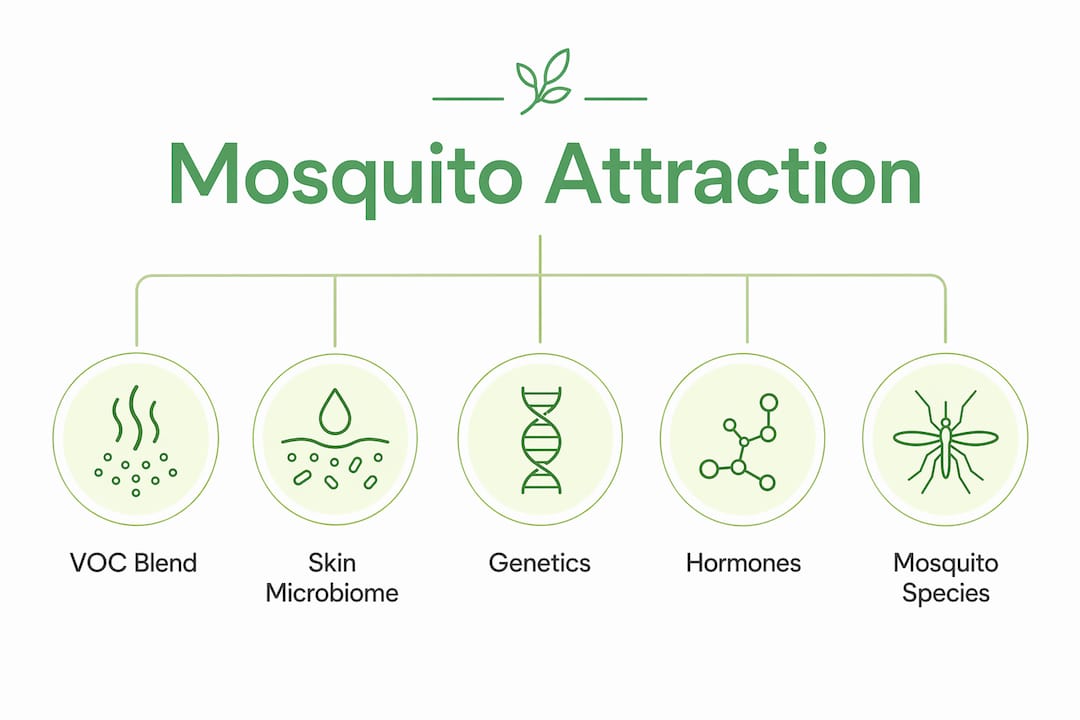
Your skin is home to trillions of bacteria, and those bacteria are largely responsible for the odors mosquitoes detect. Sweat itself is nearly odorless when it leaves your pores. Skin bacteria, including Cutibacterium, Staphylococcus, and Corynebacterium species, biotransform sweat and sebum into the volatile compounds that create your personal scent signature.
The bacterial community on your skin is as unique as a fingerprint. Four factors shape it most directly:
- Hygiene habits: Frequent washing reduces bacterial load temporarily, but your microbiome rebounds within hours. The species that return fastest tend to be the most resilient, not necessarily the least attractive to mosquitoes.
- Diet: High-protein diets increase ammonia output. Diets rich in garlic and onion alter sulfur compound emissions. What you eat changes what you smell like to a mosquito.
- Health status: Certain skin conditions alter bacterial diversity. A less diverse microbiome tends to produce a more uniform, detectable scent profile.
- Bacterial species balance: Higher abundances of Pseudomonas bacteria on skin are linked to lower mosquito attraction because these bacteria produce repellent odor compounds. This is one of the most surprising findings in recent mosquito research.
The practical implication is significant. Managing your skin microbiome, not just masking your scent, is a more effective long-term approach to reducing mosquito attraction. Probiotic skincare and gentle, non-stripping cleansers help maintain a diverse bacterial community that may naturally produce fewer attractive VOCs.
How do mosquitoes use body odor together with other senses?
Mosquitoes do not rely on body odor alone. They use a multimodal host-seeking process that integrates several sensory inputs at different distances. Understanding this sequence helps you see exactly where body odor fits in.
- Long range (30+ meters): Carbon dioxide (CO2) from your breath acts as the first beacon. It signals that a warm-blooded host is nearby and triggers active host-seeking flight.
- Medium range (1–10 meters): Body odor VOCs become detectable. The mosquito begins orienting toward the specific scent blend. This is where your personal chemistry starts to matter.
- Short range (under 1 meter): Heat, humidity, and skin moisture confirm the target. The mosquito makes its final approach and landing decision based on this combined input.
- Landing decision: Body odor functions as the critical short-range cue that determines whether a mosquito bites or moves on.
Visual cues also play a role. Mosquitoes are drawn to dark clothing and movement, which they use to confirm a host once chemical signals have guided them close enough.
Pro Tip: Wearing light-colored, loose-fitting clothing reduces both the visual and thermal signals mosquitoes use at close range, giving body odor less chance to seal the deal.
Body odor and CO2 work together rather than independently. Johns Hopkins Medicine research confirms that body odors work in concert with carbon dioxide to tip mosquitoes off to human presence. CO2 opens the door; your scent decides who gets bitten.
Why are some people more attractive to mosquitoes?
Individual variation in mosquito bite frequency is real, and it is rooted in biology. The blend ratio of VOCs across your entire scent profile, not the presence of any single compound, determines your attractiveness to mosquitoes. Two people can emit the same compounds at different ratios and experience completely different bite rates.
| Factor | Effect on mosquito attraction |
|---|---|
| Genetics | Determines baseline VOC production and skin microbiome composition |
| Hormonal status | Pregnancy and menstrual cycle phases increase octenol emission |
| Exercise intensity | Higher sweat output raises lactic acid and carboxylic acid concentrations |
| Diet | Protein-heavy or sulfur-rich foods alter ammonia and sulfur compound output |
| Skin microbiome | Bacterial species balance shifts the VOC profile toward attractive or repellent compounds |
Hormonal changes have a measurable effect. Menstrual cycle and pregnancy alter the emission of specific VOCs, particularly octenol, making certain individuals significantly more attractive to mosquitoes during those periods. This is not anecdotal. It is a documented chemical shift.
Mosquito species also vary in their preferences. Aedes aegypti favors male hosts, while Aedes albopictus is attracted to ketones, showing that different species target different chemical signatures. If you live in an area with multiple mosquito species, you may attract some more than others based on your specific chemistry.
What practical steps reduce mosquito attraction from body odor?
Reducing your mosquito attractiveness starts with understanding that simple odor masking rarely works. Because mosquito attraction depends on the full VOC blend, not a single compound, covering one scent with another does not reliably reduce bites. These steps address the underlying chemistry more directly:
- Shower before outdoor activities. Washing reduces lactic acid, carboxylic acids, and bacterial metabolites on your skin. The effect is temporary but meaningful for a few hours outdoors.
- ✅ Choose unscented or naturally scented body products. Synthetic fragrances can mimic or amplify VOCs that attract mosquitoes. Natural body care products, including those from Jeffi, use ingredients that do not add synthetic attractants to your skin.
- Support your skin microbiome. Gentle cleansers that do not strip your skin’s natural bacterial balance help maintain a diverse microbiome. A diverse microbiome is more likely to include Pseudomonas species that produce repellent compounds.
- ✅ Use natural body butters and lotions. Applying a moisturizing layer after washing can slow the re-emission of VOCs from your skin surface. Jeffi’s whipped body butters are formulated with all-natural ingredients that support skin health without synthetic chemical additions.
- Consider how fragrance interacts with your scent. Certain natural fragrance compounds alter the VOC blend on your skin in ways that may reduce mosquito interest. Exploring how body fragrance influences attraction is a practical next step for anyone who spends significant time outdoors.
- ✅ Avoid exercising immediately before outdoor events. Post-exercise skin has elevated lactic acid and ammonia concentrations. Showering after exercise and before outdoor time reduces these peaks.
Key Takeaways
Body odor drives mosquito attraction through a unique blend of VOCs shaped by genetics, skin bacteria, hormones, and diet, not by any single compound.
| Point | Details |
|---|---|
| VOC blend ratio matters most | Mosquito attraction depends on the full combination of skin VOCs, not one chemical alone. |
| Skin bacteria create the scent | Bacteria like Cutibacterium and Corynebacterium convert odorless sweat into the VOCs mosquitoes detect. |
| CO2 and body odor work together | CO2 draws mosquitoes from a distance; body odor guides the final landing decision. |
| Hormones shift your scent | Pregnancy and menstrual cycle phases increase octenol, raising mosquito attractiveness measurably. |
| Microbiome management reduces bites | Supporting Pseudomonas species on skin through gentle care may naturally lower your attractiveness. |
Why I think most people are solving this problem backwards
Most people reach for a spray the moment they step outside. That is understandable, but it treats the symptom rather than the source. After years of working with natural skin care and studying how body chemistry affects insect behavior, I have come to believe that skin health is the real foundation of mosquito defense.
Your skin microbiome is not a fixed thing. It responds to what you put on your skin, what you eat, and how you care for yourself daily. People who consistently use gentle, natural products tend to have more diverse bacterial communities. A more diverse microbiome produces a more complex, less predictable VOC profile. Mosquitoes are pattern-seekers. Disrupt the pattern, and you become a less reliable target.
The research on Pseudomonas bacteria producing repellent odors is the most exciting development I have seen in this space. It suggests that the right skin care routine is not just about smelling good to other people. It is about smelling less appealing to insects. That reframes the entire conversation around natural body care.
— Jeffi
Natural body care that works with your skin chemistry
Understanding how body odor influences mosquito attraction changes how you think about skin care. The right products do more than moisturize. They support the skin environment that keeps your VOC profile less attractive to insects.

Jeffi’s full range of natural skin care products is Non-GMO Project verified and made with all-natural ingredients that work with your skin rather than against it. The whipped body butters are a favorite for outdoor enthusiasts because they moisturize deeply without synthetic additives that could amplify attractive VOCs. Pair them with a Jeffi fragrance option to layer a natural scent that does not mimic the chemical signals mosquitoes follow. Your skin deserves care that is both safe and genuinely effective outdoors.
FAQ
What makes body odor attractive to mosquitoes?
Mosquitoes detect a blend of VOCs in body odor, including lactic acid, octenol, carboxylic acids, and ammonia. The specific ratio of these compounds, not any single chemical, determines how attractive a person is to mosquitoes.
Does showering before going outside reduce mosquito bites?
Yes. Showering removes lactic acid, carboxylic acids, and bacterial metabolites from your skin, temporarily reducing the chemical signals mosquitoes follow. The effect lasts a few hours before your microbiome and sweat glands restore the scent profile.
Why do mosquitoes bite some people more than others?
Individual differences in genetics, hormones, diet, and skin microbiome composition create unique VOC blends. Pregnant individuals and those in certain menstrual cycle phases emit higher octenol levels, increasing their attractiveness to mosquitoes.
Do different mosquito species prefer different body odors?
Yes. Aedes aegypti tends to favor male hosts, while Aedes albopictus is drawn to ketone compounds. Human scent contains over 1,000 VOCs, and each mosquito species responds to a different subset of those chemicals.
Can skin care products reduce mosquito attraction?
Natural body care products that support skin microbiome diversity and avoid synthetic chemical additions can reduce the concentration of attractive VOCs on your skin surface. Products that include Pseudomonas-friendly ingredients or natural fragrance compounds may shift your scent profile in a less attractive direction for mosquitoes.