

Bats genuinely reduce local mosquito activity, but they won’t clear your yard on their own. The strongest peer-reviewed evidence comes from an enclosure experiment with northern long-eared bats (Myotis septentrionalis), which recorded a 32% reduction in Culex egg-laying compared to bat-free controls. That’s a real, measurable effect. Still, bats are one piece of a larger puzzle, and for immediate personal protection on a summer evening, you still need a repellent you can trust on your skin.
Study Snapshot: In bat-containing enclosures, Culex mosquitoes laid an average of 8.44 egg clutches per night versus 12.42 in controls — a 32% drop in oviposition activity.
Table of Contents
- What peer-reviewed studies actually show about bats eating mosquitoes
- Why bats alone won’t eliminate your mosquito problem
- How bats fit into a homeowner’s integrated mosquito management plan
- Safe, practical ways to encourage bats at home
- What you should use alongside bats: natural repellents and bite care
- Key Takeaways
- Jeffi’s take on bats, bugs, and what actually protects you
- Natural repellents and bite relief you can use tonight
- Authoritative sources and further reading
What peer-reviewed studies actually show about bats eating mosquitoes
The science here is more nuanced than the popular “bats eat 1,000 mosquitoes an hour” headline suggests. That figure comes from lab conditions that don’t reflect natural foraging, so treat it as a ceiling, not an average.
| Study Type | Key Finding | Source |
|---|---|---|
| Enclosure experiment | 32% reduction in Culex egg-laying with northern long-eared bats present | NIH-indexed, peer-reviewed |
| Molecular diet analysis | Mosquitoes detected in bat feces but often a minority of total prey | UW–Madison / fecal DNA screening |
| Body-size study (PLOS One) | Smaller bats (4–4.5 g) show higher mosquito presence in fecal DNA than larger species | PLOS One |
| Rice-paddy field study | Bat activity correlated with adult mosquito density; mosquitoes detected in feces at sampled sites | Pest Management Science |
Molecular diet studies confirm that mosquitoes appear in bat diets across multiple species, but moths and beetles typically dominate. Body size matters too. Smaller, high-frequency echolocators are better suited to capturing mosquito-sized prey than larger, low-frequency species that prefer calorie-dense moths.
Worth knowing: The 32% oviposition reduction is the most controlled, peer-reviewed figure available for U.S. bat species. It reflects behavioral suppression as well as direct predation — bats’ echolocation alone can cause mosquitoes to avoid foraging areas, a trait-mediated effect that adds to the total reduction.
Why bats alone won’t eliminate your mosquito problem
Bats are helpful. They’re just not a silver bullet, and experts are clear about that.
- Generalist diet: Bats eat whatever is most abundant and calorie-efficient. Mosquitoes are small and low in energy, so larger prey wins when it’s available.
- Caloric math: A nursing bat may eat up to 100% of her body weight in insects nightly, but that doesn’t mean mosquitoes fill the menu.
- Timing mismatches: Bats forage at dusk and dawn; mosquitoes peak at those same windows but also remain active well into the night when bats rest.
- Spatial limits: A single bat colony covers a finite foraging range. Mosquitoes breeding in standing water 200 yards away may never be touched.
- Species differences: Not every bat in your area is a mosquito specialist. Local species composition matters.
“Bats are a valuable component of pest management, but they should be integrated with source reduction and personal repellents rather than relied on alone.” — UW–Madison researchers, summarizing the evidence
Compounding all of this: bat populations are declining. White-nose syndrome, a fungal disease, has devastated hibernating bat colonies across North America, and habitat loss continues to shrink foraging ranges. Fewer bats means less natural suppression over time, which is exactly why conservation matters to anyone who cares about chemical-free pest management.
How bats fit into a homeowner’s integrated mosquito management plan
Bats work best as one layer in a broader integrated pest management (IPM) strategy, not as a standalone fix. Think of them as a free, ecological service running in the background while you handle the rest.
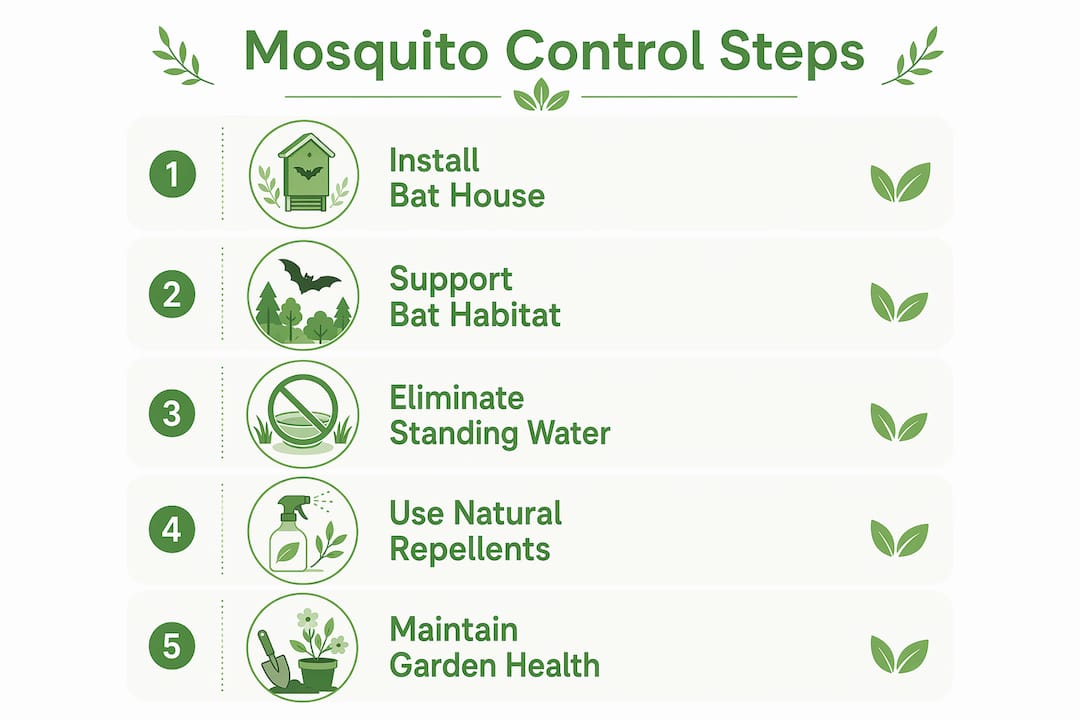
The most effective homeowner approach combines three things: eliminating mosquito breeding sites, supporting natural predators like bats, and using personal repellents when you’re actually outside. Eliminating standing water — even a bottle cap’s worth — cuts mosquito populations faster than any predator can. Bats, fish like Gambusia (mosquitofish), and dragonfly larvae all contribute to larval and adult control, but none of them replaces source reduction.
Timing your outdoor activities also helps. Mosquito activity peaks at dusk and dawn, which overlaps with bat foraging hours. If you’re outside during those windows, personal protection matters most.
Pro Tip: If you want a measurable win without overpromising, start with standing water removal. Studies consistently show it’s the single highest-impact step a homeowner can take. Bat support amplifies that baseline.
IPM in practice: Removing one small container of standing water can eliminate hundreds of larvae per week. Pair that with a bat house and a DEET-free repellent, and you’ve built a genuinely layered defense.
Safe, practical ways to encourage bats at home
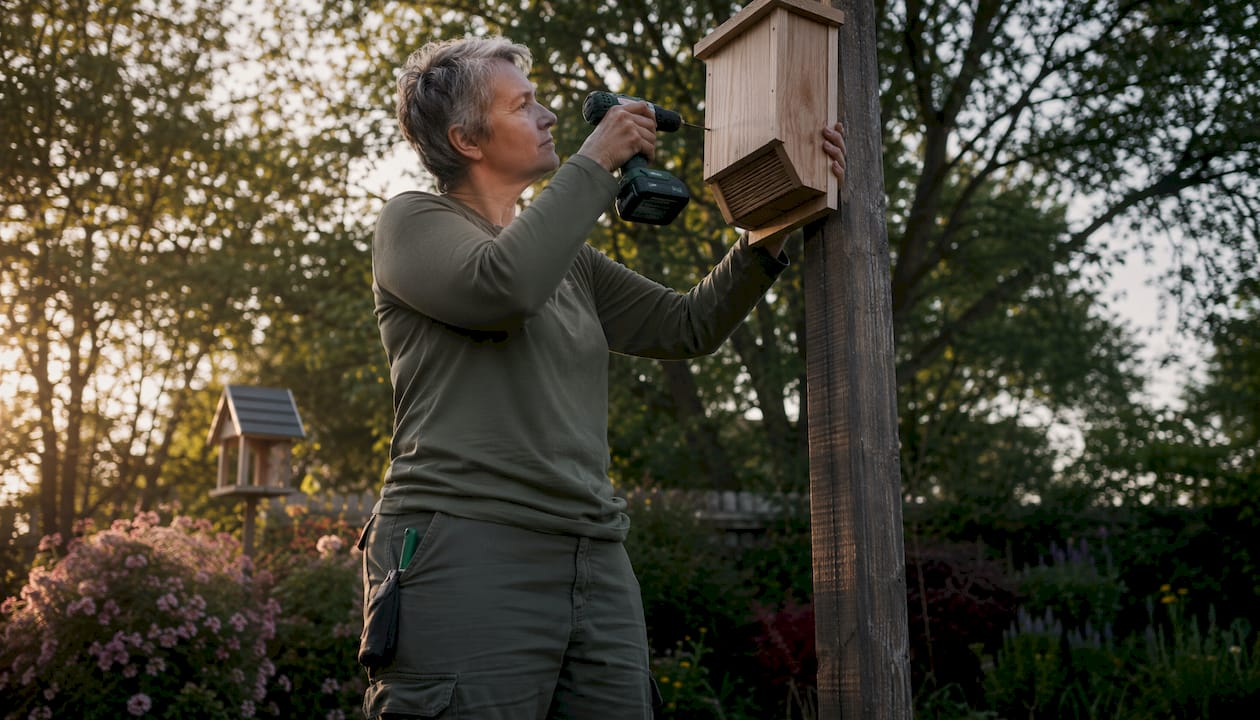
Installing a bat house is the most direct thing you can do to support local bat foraging near your property. Placement and design make or break occupancy rates. Extension guidance and Bat Conservation International both note that many commercially sold houses fail because they’re too small, poorly ventilated, or mounted in the wrong spot.
For best results, mount bat houses 12–15 feet high on a pole or building (not a tree, which invites predators), facing south or southeast to catch morning sun. Proximity to water — a pond, stream, or even a rain garden — significantly increases the chance bats will use the house. Expect occupancy to take one to two seasons; patience is part of the process.
Safety first, always:
- Never handle a bat with bare hands. Bats can carry rabies, and a grounded bat during daylight hours is a warning sign.
- If you find a bat in your home or a grounded bat outside, contact your local animal control or state wildlife agency — not a pest control company.
- Check local ordinances before excluding bats from a structure; many U.S. states protect certain bat species under wildlife laws, and exclusion during maternity season (typically May through August) may be restricted.
Pro Tip: Download the eBird or iNaturalist app and log bat sightings during evening watches. Consistent activity near your bat house is a good sign foraging is happening — and it’s genuinely fun to track.
Seasonal note: Most U.S. bat species return from hibernation or migration in April and May. That’s the best window to have your bat house installed and ready.
What you should use alongside bats: natural repellents and bite care
Even with bats foraging overhead, personal protection is non-negotiable for anyone spending time outside at dusk. The good news: you don’t need DEET to get real protection.
Repellent options that work with a natural skincare routine:
- DEET-free balms and roll-ons with botanical actives (lemon eucalyptus oil, picaridin-free plant extracts)
- Lotion-based repellents that double as moisturizers, ideal for sensitive skin
- Topical ointments formulated for after-bite relief (cooling, anti-itch)
- Fragrance-free or lightly scented options if you’re layering with sunscreen or body lotion
When you’re thinking about avoiding harsh chemicals in your routine, DEET-free repellents fit naturally alongside clean-beauty moisturizers and body butters without disrupting your skin barrier.
After a bite:
- Clean the area with mild soap and water immediately.
- Apply a non-GMO, all-natural anti-itch balm or ointment to reduce inflammation.
- Avoid scratching — it breaks the skin and increases infection risk.
- See a doctor if you develop fever, rash, or significant swelling after a bite, especially during West Nile or Zika season.
Pro Tip: Apply your repellent after moisturizer but before sunscreen. Let each layer absorb for 60 seconds before adding the next. Reapply repellent every two hours outdoors, or after swimming.
Key Takeaways
Bats reduce local mosquito activity measurably, but personal repellents remain your most reliable immediate protection — especially at dusk when both bats and mosquitoes are most active.
| Point | Details |
|---|---|
| Bats help, but don’t replace repellents | The 32% enclosure reduction is real but context-limited; personal protection fills the gap. |
| Smaller bat species are more effective | High-frequency, lighter bats consume more mosquitoes than larger species. |
| Support bats safely | Install bat houses correctly, never handle bats, and check local wildlife laws before exclusion. |
| Eliminate standing water first | Source reduction is the highest-impact step; bat foraging amplifies that baseline. |
| Jeffi DEET-free repellents | Jeffi’s all-natural, Non-GMO Project verified balms and bite-relief products pair directly with bat-friendly IPM. |
Jeffi’s take on bats, bugs, and what actually protects you
Here’s what we believe at Jeffi: the best mosquito strategy is one that works with nature, not against it. Supporting bat populations, removing standing water, and choosing DEET-free, all-natural repellents aren’t competing ideas. They’re the same idea expressed at different scales.
The science is honest about bats’ limits, and we think you deserve the same honesty about repellents. No single product or predator eliminates mosquitoes entirely. What works is layering: ecological support at the yard level, clean-ingredient protection at the skin level. Jeffi’s Non-GMO Project verified formulas are built for exactly that second layer, with ingredients you can actually read on the label.
Natural repellents and bite relief you can use tonight
Bats are doing their part at dusk. Jeffi handles the rest.

Jeffi’s DEET-free repellent balms and roll-ons are made with all-natural, Non-GMO Project verified ingredients, so you get real protection without synthetic chemicals touching your skin. Apply a balm to exposed arms and legs before you head outside, and keep a bite-relief ointment nearby for after. The formulas are gentle enough for sensitive skin and clean enough to layer with your regular moisturizer or body butter.
For a complete outdoor evening kit, the Jeffi bundles pair repellent and bite-care products together so you’re covered before and after. Or browse the full range of natural repellents and skin care to find what fits your routine. Choose clean. Choose bat-friendly. Choose Jeffi.
Authoritative sources and further reading
- Experimental Assessment of the Impacts of Northern Long-Eared Bats on Ovipositing Culex Mosquitoes — NIH-indexed enclosure study; source of the 32% oviposition reduction figure.
- Study bolsters bats’ reputation as mosquito devourers — UW–Madison News — covers molecular diet evidence and expert commentary on diet composition and bat declines.
- ️ Insect pest management services provided by bats — UF/IFAS Extension (WEC245/UW289) — practical homeowner guidance on bat houses, IPM integration, and trait-mediated effects.
- Mosquito consumption by insectivorous bats: does size matter? — PLOS One — links bat body size and echolocation frequency to mosquito consumption rates.
- Bats actively prey on mosquitoes in rice paddies — Pest Management Science — field evidence of bat predation on mosquitoes in agricultural settings with public-health implications.
- ️ Bats help reduce the spread of mosquito-borne diseases — Jackson County Vector Control District — accessible public-health summary of bat predation efficiency and disease-reduction context.