

DEET is unsafe for children mainly when it is misused. Applying it to broken skin, under clothing, or too frequently raises absorption dramatically, and children’s bodies absorb chemicals faster than adults’ because of their higher surface-area-to-body-weight ratio and more sensitive skin. The good news: Poison Control Center data from more than 9,000 DEET exposures found no evidence that children develop adverse effects more often than adults when DEET is used correctly. The risk is real, but it is almost entirely tied to how the product is applied, not the ingredient itself.
Quick summary of what makes DEET risky for kids:
- Applying to broken, irritated, or abraded skin sharply increases absorption
- Using under clothing traps DEET against skin and raises systemic exposure
- Applying to children’s hands, which then touch their mouths and eyes
- Reapplying too frequently without washing skin between uses
- Using high-concentration formulas on young children
- Swallowing DEET, even in small amounts, from unwashed hands or contaminated food
What are the real risks of DEET exposure in children?
DEET’s risks in children fall into two categories: local skin reactions and systemic reactions. Local reactions, including redness, rash, and a burning sensation, tend to appear with repeated applications or highly concentrated formulas above 75%. Systemic reactions are more serious and occur when DEET absorbs through the skin into the bloodstream.
Once absorbed systemically, DEET can affect the nervous system. Reported effects include confusion, drowsiness, muscle weakness, muscle spasms, seizures, and in extreme cases, coma. Children are more vulnerable because their skin is thinner and their surface-area-to-weight ratio is higher, meaning a given amount of DEET covers proportionally more of their body and absorbs at a greater rate.
Statistical context: 23–29% of children in the United States are exposed to DEET, while 3–5% of children experience seizures from any cause. This overlap means some reported DEET-seizure associations may be coincidental rather than causal.
The most common misuse patterns that lead to toxicity include:
- Applying DEET to skin that is then covered with clothing
- Using it on cuts, bruises, or skin conditions
- Allowing children to apply it themselves
- Spraying near the mouth, eyes, or ears
- Reapplying multiple times in a single day without washing the skin
Serious adverse events are rare when DEET is used as directed. The DEET toxicity profile from the Agency for Toxic Substances and Disease Registry confirms that most severe cases result from extreme misuse, not standard label-compliant application.
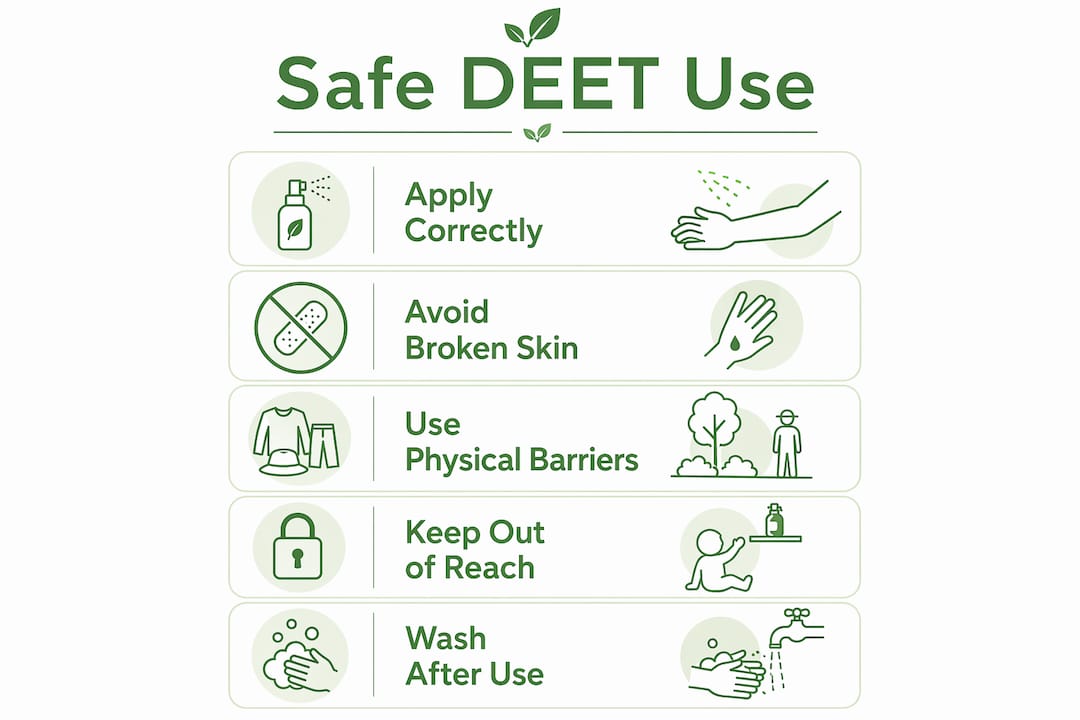
How to apply DEET safely on your child
Safe application is everything. The American Academy of Pediatrics and the CDC have published clear guidelines, and following them reduces risk to a very low level.
Age and concentration rules:
- ✅ Do not use DEET on infants under 2 months old
- ✅ For children ages 2–12, use products with a lower concentration of DEET
- ✅ Products with moderate DEET concentration provide adequate protection for most conditions in older children and adults
- ✅ Higher concentrations of DEET do not extend protection time and may raise irritation risk
Application technique:
- Apply DEET to your own hands first, then rub it onto your child’s skin
- Avoid the face, hands, eyes, lips, and any broken or irritated skin
- Never spray directly onto a child’s face
- Do not apply under clothing
Reapplication and hygiene:
- A single application at the right concentration is effective for 4–8 hours, so reapplication is rarely needed
- Wash treated skin with soap and water when you come back indoors
- Wash clothing sprayed with DEET before wearing it again
- Wash hands thoroughly after applying to prevent DEET from transferring to food or a child’s mouth
Pro Tip: Keep repellent containers out of children’s reach entirely. The AAP specifically advises that children under 10 should never apply DEET themselves.
Physical barriers reduce how much repellent you need in the first place. Long sleeves, long pants, and avoiding outdoor time during peak mosquito hours (dawn and dusk) are recommended as the primary protective strategy before reaching for any repellent.

Natural alternatives to DEET that are safer for kids
Parents who want to reduce or skip DEET entirely have real options. Several plant-based repellents carry EPA registration, meaning they have been reviewed for both safety and efficacy. That said, “natural” does not automatically mean risk-free. Even plant-based repellents require careful application and should be kept away from eyes, mouths, and broken skin.
EPA-registered natural active ingredients to look for:
- Oil of lemon eucalyptus (OLE): One of the most effective natural options, though not recommended for children under 3
- Picaridin: Synthetic but derived from a plant compound; generally well-tolerated on sensitive skin
- IR3535: An amino acid-based repellent with a good safety profile for children
- Soybean oil: Products with 4.75% DEET and 2% soybean oil each provided roughly 1.5 hours of protection in comparative testing
Natural repellents often require more frequent reapplication than DEET to maintain protection, so check the label and reapply as directed.
Physical prevention strategies that work alongside any repellent:
- Dress children in light-colored, long-sleeved clothing
- Use mosquito nets over strollers and beds
- Stay indoors during peak biting hours at dawn and dusk
- Remove standing water from your yard to reduce mosquito breeding
For families who prioritize clean, plant-based skin care, gentle plant-based formulas built around natural oils and botanicals show how effective skin protection can come from ingredients you can actually recognize. Jeffi’s approach to natural mosquito protection follows the same principle: ingredients that are transparent, Non-GMO Project verified, and formulated with children’s sensitive skin in mind. You can explore Jeffi’s natural repellent options to see what fits your family’s routine.
Key Takeaways
DEET is safe for children when used correctly, but misuse, especially applying under clothing or to broken skin, raises absorption and toxicity risk significantly.
| Point | Details |
|---|---|
| Misuse drives most risk | Applying under clothing, on broken skin, or too frequently causes most DEET-related adverse events in children. |
| Children absorb more | A higher surface-area-to-body-weight ratio means children absorb proportionally more DEET than adults. |
| Age-based concentration limits | The American Academy of Pediatrics recommends no more than 10% DEET for children ages 2–12. |
| One application lasts | A single correct application is effective for 4–8 hours; reapplying unnecessarily raises cumulative exposure. |
| Jeffi natural alternative | Jeffi offers Non-GMO Project verified, all-natural mosquito protection formulated for families who want to avoid synthetic repellents. |
Keeping kids safe from mosquitoes: Jeffi’s perspective
The conversation around DEET safety often swings between two extremes: parents who use it without a second thought, and parents who avoid it so completely that their children end up with no protection at all. Neither extreme serves kids well. The research is clear that DEET, used correctly and at appropriate concentrations, carries a low risk of serious harm. The problem is that “used correctly” requires more attention than most product labels communicate clearly.
What tends to get overlooked is that concentration is only part of the equation. Frequency of application and where on the body DEET is applied matter just as much. A parent who reapplies a low-concentration product four times in a day may expose their child to more cumulative DEET than one who applies a higher concentration once. That nuance rarely makes it onto the bottle.
Physical barriers, choosing the right repellent for the situation, and washing skin after outdoor time are habits worth building regardless of which product you use. For younger children or those with sensitive skin, natural alternatives are worth trying first. The goal is protection, not a specific chemical.
Jeffi’s natural protection for families who want a safer choice
Mosquito season should mean backyard fun, not a stressful label-reading session at the store. Jeffi makes that easier. Every product is Non-GMO Project verified, all-natural, and formulated without synthetic chemicals, so you get real protection without the worry that comes with conventional repellents.

Jeffi’s whipped body butters and hand and body lotions are built for sensitive skin, including children’s, using plant-based ingredients you can actually pronounce. If you are ready to move away from DEET and toward something your whole family can feel good about, visit Jeffi’s full product line to find the right fit for your outdoor routine.