

Your skin microbiome directly controls how attractive you are to mosquitoes. The bacteria living on your skin metabolize sweat into volatile organic compounds (VOCs), and those compounds act as chemical signals that guide mosquitoes straight to you. It is not just about sweating more or having warmer skin. The specific mix of microbes you carry determines your personal odor fingerprint, and mosquitoes read that fingerprint with remarkable precision.
Here is what the science shows at a glance:
- Staphylococcus and Corynebacterium species are the primary producers of mosquito-attracting volatiles, including lactic acid, ammonia, and short-chain carboxylic acids.
- Mosquitoes use CO2 as a long-range activator, then switch to skin microbial odors at close range to select a landing site.
- People with less diverse, Staphylococcus-dominant microbiomes tend to attract more mosquitoes than people with diverse, Pseudomonas-enriched communities.
- Individual variation in microbial composition explains why some people get bitten far more often than others in the same setting.
- Microbial metabolites act as short-range chemical cues that either amplify or suppress the mosquito’s drive to land and feed.
How microbiome composition shapes your mosquito attractiveness
Not all skin microbiomes are equal when it comes to mosquito attraction factors. The diversity and abundance of bacterial species on your skin both matter, but they pull in opposite directions.
Research published in BMC Microbiology found that individuals with higher skin microbiota diversity are less attractive to mosquitoes, while those with abundant Staphylococcus species are significantly more attractive. Specifically, Staphylococcus amplicon sequence variants (ASVs) are four times as abundant in highly attractive individuals compared to poorly attractive ones. That is a striking difference driven entirely by microbial community structure, not by anything the host consciously controls.
On the other side of the spectrum, a more diverse microbiome enriched with Pseudomonas species correlates with reduced attractiveness to Anopheles gambiae females. The metabolic pathways active in Staphylococcus-heavy communities produce higher concentrations of lactic acid and short-chain carboxylic acids, the very compounds mosquitoes are tuned to detect. Pseudomonas-enriched communities appear to generate a different volatile profile that is less stimulating to mosquito olfactory receptors.
- Higher Staphylococcus abundance produces more lactic acid and carboxylic acids.
- Greater microbial diversity, especially with Pseudomonas, associates with lower mosquito attraction.
- Metabolic differences between bacterial genera drive the variation in volatile output.
- Microbial fingerprints help explain why attraction differences persist even among people in the same room.
Pro Tip: If you are designing a study on individual mosquito attractiveness, controlling for skin microbiome composition is as important as controlling for CO2 output. Without it, your attraction data will carry unexplained variance.
Which chemical compounds from skin bacteria actually attract mosquitoes?
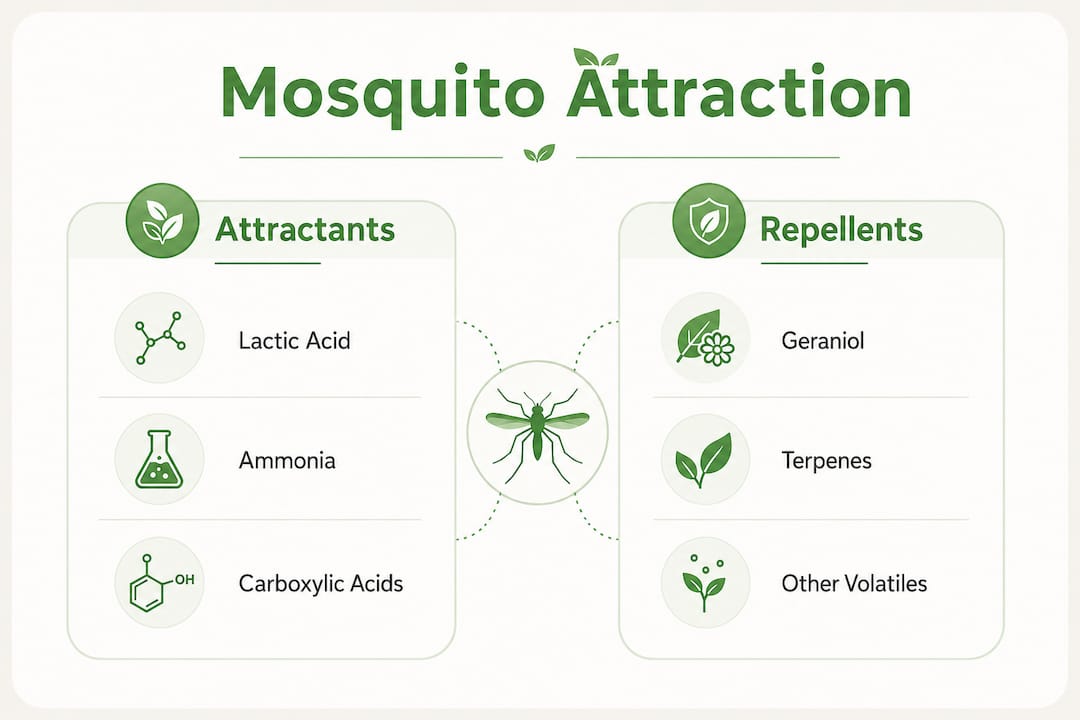
The relationship between skin flora and mosquitoes comes down to specific molecules. Skin bacteria metabolize nutrients secreted by eccrine, apocrine, and sebaceous sweat glands, converting amino acids, fatty acids, and salts into a cocktail of small volatile molecules. The key odorants produced include lactic acid, ammonia, and short- to medium-chain carboxylic acids, all of which synergize with CO2 to attract mosquitoes.

Staphylococcus species convert aliphatic amino acids from eccrine secretions into short-chain carboxylic acids. Corynebacterium species take lipids from sebaceous secretions and break them down into long-chain carboxylic acids, then further into short-chain forms. The result is a layered chemical profile that differs between body regions, between individuals, and even across the day as bacterial populations grow and shift.
Crucially, mosquito attraction depends on a combinatorial chemical code, not a single compound. Changing one volatile can unpredictably shift the entire behavioral response. Acetic acid, for example, attracts mosquitoes at low concentrations but repels them at high concentrations, and that switch only happens in the presence of lactic acid. Remove lactic acid, and acetic acid triggers almost no behavioral response at all.
| Compound | Source bacteria | Effect on mosquitoes |
|---|---|---|
| L-(+)-lactic acid | Staphylococcus, Corynebacterium | Key attractant; gates short-range behavior |
| Ammonia | Multiple skin bacteria | Attractant; synergizes with lactic acid |
| Short-chain carboxylic acids | Staphylococcus spp. | Amplify attraction to lactic acid and CO2 |
| 2-methyl butyric acid | Skin commensals | Repellent at tested concentrations |
| 3-methyl butyric acid | Skin commensals | Strong repellent |
| Geraniol (terpene) | Skin microbiome-associated | Repellent; reduces landing behavior |
| Acetic acid | Staphylococcus spp. | Concentration-dependent: attracts or repels |
| Octanal | Skin bacteria | Attracts at very low doses; repels at higher doses |
Some compounds that skin bacteria produce can actually work against mosquito attraction. The terpene geraniol, for instance, reduced mosquito landing by 74.9% in controlled assays, and 2- and 3-methyl butyric acids reduced landing by 62.0–81.6% and 87.1–99.6%, respectively. These findings open a real path toward using the skin microbiome itself as a source of natural repellent compounds.
How mosquitoes actually find you using skin odor cues
Mosquito host-seeking is a stepwise process, and skin microbial odors play a specific role at each stage. Understanding the mechanism helps clarify why simply masking one odor rarely stops a determined mosquito.
CO2 acts as a behavioral gatekeeper, switching mosquitoes from a resting state into active host-seeking mode and sharpening their tracking of odor plumes. Mosquitoes can detect CO2 and skin odors at 10–15 meters; infrared heat becomes relevant at roughly 0.7–0.8 meters, and convection heat and humidity only within 10 centimeters of the skin. That layered detection system means a mosquito is already committed to approaching you long before it can sense your body warmth.
At short range, lactic acid and ammonia together gate the mosquito’s response to all other skin volatiles. Without those two compounds present, other carboxylic acids produced by skin bacteria trigger little to no behavioral response. Vision also plays a role at this stage, helping the mosquito orient toward the host once olfactory signals have drawn it close. The full picture is a multimodal integration of chemical, thermal, and visual cues, with microbial volatiles providing the critical short-range specificity.
Engineering the skin microbiome to reduce mosquito attraction
The most exciting recent development in this field is the use of genetic engineering to modify skin bacteria directly. Rather than applying a repellent that wears off in hours, researchers are asking whether the bacteria already living on your skin can be reprogrammed to produce fewer attractants.
A 2024 study published in PNAS Nexus targeted the L-lactate dehydrogenase gene (l-ldh) in two common skin commensals, Staphylococcus epidermidis and Corynebacterium amycolatum. Deleting this gene reduced their production of L-(+)-lactic acid, the key odorant that gates mosquito short-range attraction. Here is what the results showed:
- Reduced attraction in vitro. Engineered strains of both S. epidermidis and C. amycolatum were significantly less attractive to mosquitoes in culture-based olfactometer assays than their wild-type counterparts.
- Sustained protection in mouse models. Mice colonized with the engineered S. epidermidis Δl-ldh strain showed reduced mosquito attraction for up to 11 consecutive days after colonization.
- Reduced feeding desire. Mosquito feeding was deterred for 7 consecutive days in contact assays, not just landing behavior.
- Longer protection than DEET. DEET, the leading chemical repellent, provides protection for only a few hours and requires constant reapplication. The engineered microbiome approach lasted up to 11 days in the mouse model.
- Self-replicating protection. Because the engineered bacteria colonize the skin and replicate, the protection is theoretically self-sustaining without repeated application.
The translational challenges are real. Human skin is a far more complex ecosystem than mouse skin, and whether engineered S. epidermidis or C. amycolatum strains can successfully compete against the existing wild-type microbiome in humans remains an open question. Still, the concept of a living, long-lasting microbiome-based repellent represents a genuine shift in how vector control could work.
How your environment and lifestyle shape your mosquito-attracting microbiome
Your skin microbiome is not fixed. Diet, hygiene habits, geography, and even the people you live with all influence which bacteria colonize your skin and in what proportions, which in turn shapes how attractive you are to mosquitoes.

Diet is one of the more underappreciated factors. Different food regimes can alter skin microbiome composition, and those shifts change the volatile profile your skin emits. High-protein diets, for example, increase amino acid availability in sweat, giving Staphylococcus bacteria more substrate to convert into short-chain carboxylic acids. Alcohol consumption raises skin lactic acid output. Neither effect is dramatic on its own, but over time, consistent dietary patterns can meaningfully shift your microbial community.
Hygiene practices matter too, though not always in the direction people expect. Aggressive washing with antibacterial soaps disrupts the skin microbiome by reducing bacterial diversity, which can paradoxically shift the community toward Staphylococcus-dominant populations that are harder to displace and more attractive to mosquitoes. Gentler, microbiome-conscious skincare, including products that support rather than strip the skin barrier, tends to preserve the diversity that correlates with lower mosquito attraction. Skincare routines that nurture your skin’s natural flora, like those incorporating nourishing body butters and gentle scrubs, align with what the science suggests about maintaining a healthier microbial balance.
Geographic and environmental factors add another layer. Humidity and temperature affect both sweat gland activity and bacterial growth rates. People living in hot, humid climates typically have higher bacterial loads on their skin and produce more volatile compounds overall. Seasonal variation in skin microbiome composition has been observed, with summer months generally producing more diverse and active communities due to increased sweating and outdoor exposure.
How your genes influence your skin microbiome and mosquito attractiveness
The connection between genetics and mosquito attraction runs deeper than most people realize. Your DNA does not just determine your blood type or skin color. It also shapes the environment your skin provides for bacteria, which in turn determines the volatile compounds those bacteria produce.
Research on twins has shown that the human skin microbiome is partly heritable. Gram-negative bacteria of the Roseomonas genus were identified as among the most heritable in a study of Korean twins. More relevant to mosquito attraction, the abundance of Corynebacteria on the skin was found to be associated with a polymorphism in a gene related to epidermal barrier function. Since Corynebacterium species are significant producers of mosquito-attracting volatiles, this creates a direct genetic pathway to mosquito attractiveness: a gene variant affects the skin barrier, which changes the microbial niche, which changes the volatile output.
Human sweat composition itself is genetically influenced. The ratio of amino acids, fatty acids, and salts in eccrine and apocrine secretions varies between individuals partly due to genetic factors, and those differences determine which bacterial metabolic pathways are most active. Compared with other primates, human skin carries far higher concentrations of free lactic acid, a difference that appears to be tied to the unique composition of human eccrine secretions. That evolutionary quirk may be one reason anthropophilic mosquitoes are so specifically tuned to human odor.
The practical implication is that some people are genetically predisposed to carry microbiomes that produce more mosquito-attracting volatiles, and no amount of lifestyle modification will fully override that baseline. This does not mean intervention is pointless. It means that effective strategies, whether microbiome engineering or targeted skincare, need to account for individual genetic variation rather than assuming a one-size-fits-all approach will work.
What the science tells us about skin bacteria and mosquito bites
The core findings from current research are clear and consistent across multiple study designs.
- Microbial volatile profiles drive attraction. Body odor results primarily from bacterial metabolism of sweat, not from sweat itself. Freshly secreted sweat is barely attractive to mosquitoes; sweat incubated with bacteria becomes strongly attractive.
- Microbiome diversity reduces attractiveness. A more diverse skin community, particularly one enriched with Pseudomonas, correlates with lower mosquito attraction. A Staphylococcus-dominant, less diverse microbiome correlates with higher attraction.
- Engineering the microbiome shows real promise. Deleting the l-ldh gene in S. epidermidis and C. amycolatum reduced mosquito attraction for up to 11 days in mouse models, far outlasting conventional chemical repellents.
- The chemical code is combinatorial. No single compound fully explains attraction or repellency. Lactic acid and CO2 together gate the response to all other volatiles, which means interventions need to target the gating compounds, not just individual attractants.
- Genetics and environment both contribute. Individual attractiveness reflects a combination of heritable microbiome traits, lifestyle factors, and the skin’s chemical environment, all of which interact in ways that are still being mapped.
The case for microbiome-based repellents as the next frontier
The conventional approach to mosquito repellents has always been chemical: apply DEET, wait a few hours, reapply. That model has served public health for decades, but it has real limitations, especially in malaria-endemic regions where cost and logistics make constant reapplication impractical.
The microbiome-based approach flips the model entirely. Instead of masking your odor temporarily, you modify the source of the odor at the bacterial level. A living, self-replicating bacterial strain that produces fewer attractants does not wear off between applications. It colonizes, competes, and persists. The engineered microbiome strategy offers durable protection with a lower logistical burden, which is exactly what vector control programs in resource-limited settings need.
That said, the path from mouse model to human application is not straightforward. Human skin hosts a far more complex and competitive microbial ecosystem than mouse skin. Engineered strains need to colonize effectively, compete against established wild-type populations, and remain stable without triggering immune responses or disrupting skin homeostasis. Synthetic biology tools are advancing rapidly, and the combination of CRISPR-based gene editing with deep metagenomic profiling of individual skin microbiomes is making precision engineering more feasible. But the regulatory and safety frameworks for applying genetically engineered bacteria to human skin are still being developed.
The most realistic near-term path may be a hybrid approach: engineered or probiotic-supplemented microbiome interventions used alongside conventional repellents, with each strategy reinforcing the other. For the broader public, supporting skin microbiome diversity through natural, gentle skincare is already a meaningful step in the right direction, even before engineered solutions reach clinical use.
Jeffi’s natural approach to skin health and mosquito deterrence
Science keeps confirming what Jeffi has always believed: a healthy, balanced skin microbiome is your first line of defense against mosquitoes. You do not need harsh chemicals to support that balance. You need products that work with your skin, not against it.

Jeffi’s natural mosquito repellent and skincare line is Non-GMO Project verified and made with all-natural ingredients that respect your skin’s microbial ecosystem. The whipped body butters nourish the skin barrier without stripping the beneficial bacteria that keep your odor profile in check. Jeffi’s fragrances are crafted to complement your skin’s natural chemistry rather than overwhelm it. Every product is designed for people who want effective, eco-friendly protection they can feel good about.
Key takeaways
The skin microbiome shapes mosquito attraction by producing the volatile compounds that mosquitoes use to locate and select human hosts, making microbial composition one of the most powerful and modifiable mosquito attraction factors.
| Point | Details |
|---|---|
| Microbiome diversity matters | Higher skin bacterial diversity, especially Pseudomonas enrichment, correlates with lower mosquito attraction. |
| Staphylococcus drives attraction | Staphylococcus ASVs are four times as abundant in highly attractive individuals, producing more lactic acid and carboxylic acids. |
| Engineered bacteria last longer | Genetically modified S. epidermidis and C. amycolatum reduced mosquito attraction for up to 11 days in mouse models, far outlasting the few hours protection typically provided by DEET. |
| Genetics and lifestyle both contribute | Heritable microbiome traits and lifestyle factors like diet and hygiene both shape your skin’s volatile profile and mosquito attractiveness. |
| Jeffi supports skin microbiome health | Jeffi’s Non-GMO, all-natural skincare products nourish the skin barrier without disrupting the beneficial bacteria that influence mosquito deterrence. |