

Neighbor yards are a primary driver of local mosquito populations, supplying breeding sites and migration corridors that push biting pressure across property lines into your own backyard. Understanding what role neighbor yards play in local mosquito spread explains why your yard can feel overrun even after you’ve eliminated every puddle and standing container on your own property. Mosquitoes travel several hundred yards to several miles, making the idea of a mosquito-free yard without neighborhood cooperation more wishful thinking than reality. NC State Extension and public health entomologists agree: lasting relief requires collective action, not solo effort.
What role do neighbor yards play in local mosquito spread?
Mosquitoes are not territorial. They do not recognize property lines, and they move freely between yards based on where food, shade, and water are available. A single neglected yard on your block can sustain a mosquito population large enough to affect every home within a quarter mile.
The core mechanism is simple. Neighboring yards with shade, brush, and standing water raise the local biting pressure for every homeowner nearby. That means your neighbor’s clogged gutter or overgrown shrubs directly affect how many mosquitoes land on you during a backyard cookout.

This is the concept public health professionals call “source reduction at scale.” Eliminating one breeding site on your property helps, but it does not stop the steady flow of adults hatching next door and flying in. The impact of nearby properties on mosquitoes is real, measurable, and worth taking seriously.
How far do mosquitoes travel between yards?
Mosquito flight range is the first thing most homeowners underestimate. Flight distances vary by species but commonly span from a few hundred yards to several miles. That range covers most residential neighborhoods in a single night.
Several environmental factors shape how mosquitoes move between properties:
- Wind direction and speed. Seasonal wind shifts are a major factor in mosquito dispersal, influencing when spikes in biting activity occur. A shift in prevailing wind can push a cloud of newly hatched adults from one end of a block to the other.
- Vegetation corridors. Fences, hedge lines, and low-hanging branches serve as transit paths that facilitate movement between properties. Mosquitoes hop along these structures rather than flying in open air.
- Short hops versus long drift. Most mosquitoes make short, targeted movements toward heat and carbon dioxide. Wind-assisted dispersal covers longer distances and explains sudden population spikes after weather changes.
- Temperature and humidity. Warm, humid conditions extend daily activity windows and push mosquitoes to range farther in search of hosts.
Pro Tip: Track wind direction on days when mosquito activity spikes in your yard. You will often find the source upwind, in a neighbor’s yard or a low-lying area nearby.
Understanding wind patterns and microhabitats helps you anticipate when and where mosquitoes will arrive, so you can time your personal protection and yard treatments more effectively.
What breeding sites in neighbor yards fuel mosquito populations?
The most productive mosquito breeding sites are almost never the obvious ones. Visible ponds and birdbaths get the blame, but the real culprits are hidden water collections that nobody thinks to check.
Corrugated drain pipes and tarps hold standing water for weeks inside their folds and ridges. These spots are invisible from a sidewalk and rarely appear on any homeowner’s inspection checklist. A single tarp fold can produce hundreds of adults before anyone notices.
Common breeding sites found in neighbor yards include:
- Clogged gutters. A 10-foot section of leaf-packed gutter can produce more mosquitoes than a backyard pond. Gutters are high, out of sight, and rarely cleaned more than once a year.
- Tarps and covers. Any tarp draped over firewood, a boat, or lawn equipment collects water in its folds within hours of rain.
- Neglected pools and spas. An unmaintained pool turns into a breeding ground within days of the pump going off.
- Flower pot saucers and buckets. Small containers hold just enough water to support a full mosquito development cycle.
- Corrugated drain pipes. Water pools inside the ridges and stays there long after the surface appears dry.
Mosquito development from egg to biting adult takes as little as 7 to 14 days. Eggs can also remain dormant for months or years until flooded. That dormancy means a dry container in a neighbor’s yard is not a safe container.
Pro Tip: When you walk your own yard, also glance over the fence line. You do not need to trespass. A quick visual scan from your property often reveals tarps, buckets, or debris that your neighbor may not have noticed.
How does yard layout affect mosquito pressure across property lines?
Yard design shapes where mosquitoes rest, feed, and move. Dense shrubbery, deep shade, and humid corners create ideal resting zones that keep mosquitoes close to your property all day, ready to bite at dusk.
Managing vegetation and removing water-holding containers can reduce mosquito encounter rates by 12–28%. That is a meaningful reduction from landscaping choices alone, without any chemical treatment.
| Yard feature | Effect on mosquitoes | Practical adjustment |
|---|---|---|
| Dense shrubs near fence lines | Creates shaded resting zones and transit corridors | Trim lower branches; increase airflow |
| Tall grass and ground cover | Holds moisture and provides daytime shelter | Mow regularly; keep grass below 4 inches |
| Shaded, damp corners | Extends mosquito activity into daylight hours | Improve drainage; add gravel or mulch |
| Fence lines with vegetation | Acts as a runway between adjacent properties | Clear vegetation within 12 inches of fences |
| Open containers and low spots | Collects standing water after rain | Level ground; store containers upside down |
Mosquitoes use yard structural features as runways to travel between properties. Placing repellent barriers or treated zones at these transition points, specifically along fence lines and hedge rows, increases the effectiveness of any treatment you apply. Thinking about your yard as a series of entry points rather than a single space changes how you approach protection.
How can homeowners work with neighbors to control mosquitoes?
Collective neighborhood efforts to eliminate standing water and inspect yards produce mosquito population reductions that isolated treatments cannot match. One yard treated perfectly still receives a steady supply of adults from untreated properties nearby.
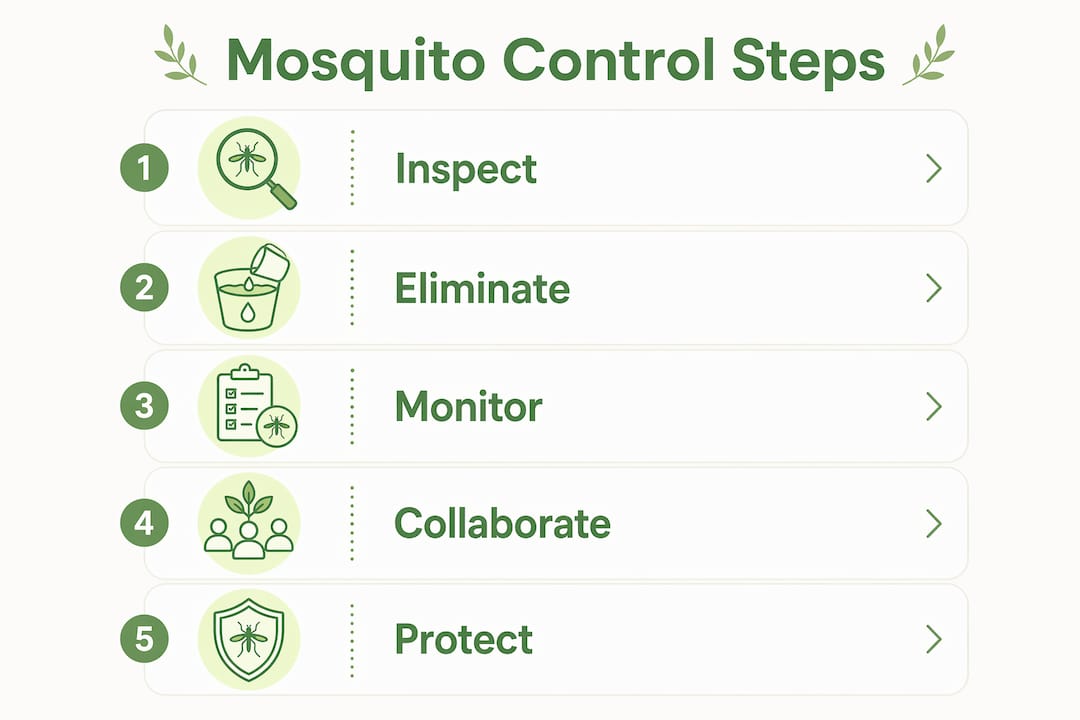
The most effective approach follows a few clear steps:
- Start a conversation, not a complaint. Approach neighbors with information, not accusations. Share what you have learned about hidden breeding sites. Most people are unaware their gutter or tarp is the source of the problem.
- Form a “mosquito squad.” Organize a small group of two to four households to inspect yards together on a set schedule, ideally every two weeks during peak season (june through september). Collective inspections catch sites that individual homeowners miss.
- Coordinate treatment timing. If multiple households treat their yards on the same day, adult mosquitoes have nowhere to flee and resettle. Staggered treatments push mosquitoes from one yard into another.
- Share a simple checklist. A one-page list of the most common breeding sites, including gutters, tarps, corrugated pipes, and flower pot saucers, gives neighbors a concrete starting point without requiring expert knowledge.
- Celebrate wins together. When biting pressure drops noticeably after a coordinated effort, acknowledge it. Positive reinforcement keeps neighbors engaged through the full season.
Community-based mosquito control modeled on island eradication programs produces more lasting population reductions than individual treatments alone. The island approach works because it removes every breeding site within a defined area simultaneously. Your neighborhood can replicate that logic at the block level.
Pro Tip: Homeowners often rely on bug zappers as their primary tool. Bug zappers do not target mosquitoes effectively and miss the core strategy of eliminating standing water. Skip the zapper and put that energy into a neighborhood inspection instead.
Key Takeaways
Neighbor yards are a direct source of mosquito breeding and migration, and individual yard treatments alone cannot overcome the pressure from adjacent properties without community-wide source reduction.
| Point | Details |
|---|---|
| Mosquitoes ignore property lines | Flight ranges of hundreds of yards to miles mean neighbor yards directly affect your biting pressure. |
| Hidden sites are the biggest threat | Clogged gutters and tarp folds produce more mosquitoes than visible ponds or birdbaths. |
| Landscaping reduces encounters | Trimming vegetation and improving drainage can cut mosquito encounter rates by 12–28%. |
| Coordination beats solo treatment | Synchronized neighborhood inspections and treatments eliminate breeding sites more effectively than individual efforts. |
| Personal protection still matters | Barrier treatments on your own property reduce bites even when migration from nearby yards continues. |
What I’ve learned from watching neighborhoods fight mosquitoes
Most homeowners focus entirely on their own yard and feel frustrated when the mosquitoes keep coming back. I understand that frustration completely. You do everything right, eliminate every puddle, trim every shrub, and still spend your evening slapping your arms. The problem is almost always next door, or two doors down.
What I have seen work, time and again, is the moment a homeowner stops thinking about their property line and starts thinking about their block. That shift in perspective changes everything. One conversation with a neighbor about a forgotten tarp or a clogged gutter can eliminate a breeding site that was feeding the entire street.
The other misconception I see constantly is the belief that a single treatment fixes the problem for the season. Mosquito eggs stay dormant for months. One good rain after a dry spell can trigger a hatch from sites you thought were dry and safe. Consistent, repeated inspection is the only thing that works.
Personal protection matters too. Even in a well-managed neighborhood, some mosquitoes will always find their way in. Having a reliable, natural repellent on hand means you can enjoy your yard without waiting for perfect conditions. The goal is not zero mosquitoes. The goal is a yard where you can breathe, laugh, and stay outside without reaching for your sleeve every thirty seconds.
— Jeffi
Natural protection that works alongside your neighborhood plan
Neighborhood source reduction is the foundation of mosquito control, and personal protection is the layer that keeps you comfortable while the community effort takes hold.

Jeffi’s natural mosquito repellent products are Non-GMO Project verified and made with all-natural ingredients, so you can apply them confidently on skin without worrying about harsh chemicals. They are designed for homeowners and outdoor enthusiasts who want effective protection that fits a natural lifestyle. Pair Jeffi’s repellents with your neighborhood mosquito control plan, and you cover both sides of the problem: fewer mosquitoes breeding nearby, and real protection for the ones that still get through. Jeffi also offers whipped body butters to soothe and moisturize skin after time outdoors, because good skin care and mosquito protection go hand in hand.
FAQ
How far can mosquitoes travel from a neighbor’s yard?
Mosquitoes travel from a few hundred yards to several miles depending on species and wind conditions. This range means a single neglected yard can affect every home within a large residential block.
What is the most overlooked mosquito breeding site in neighbor yards?
Clogged gutters and tarp folds are the most overlooked sites. A 10-foot section of leaf-packed gutter can produce more mosquitoes than a full backyard pond.
Can I control mosquitoes if my neighbor won’t cooperate?
Barrier treatments on your own property reduce bites by targeting resting adult mosquitoes, even when nearby yards continue to breed them. Personal repellents add a second layer of protection.
Are mosquitoes territorial to specific yards?
Mosquitoes are not territorial. They move freely based on available water, shade, and hosts, crossing property lines without any preference for a single yard.
How quickly can a breeding site produce biting mosquitoes?
Mosquito development from egg to biting adult takes as little as 7 to 14 days, which is why consistent, regular inspection of all water-holding sites is the only reliable control strategy.