

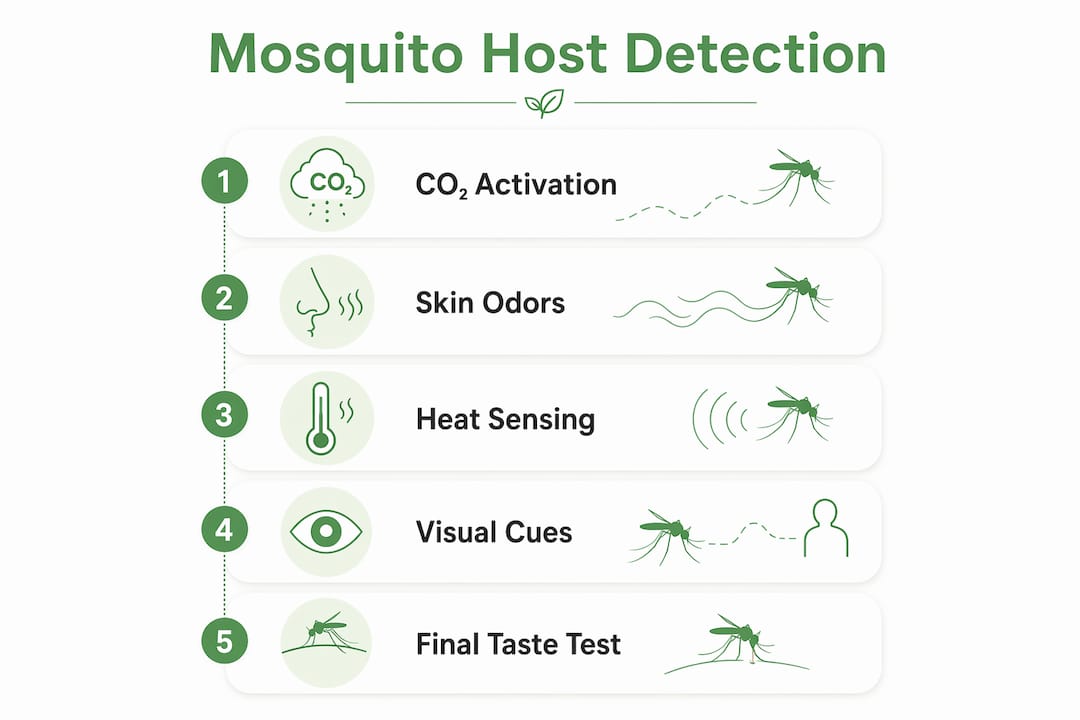
Mosquitoes locate human hosts through a layered, multi-sensory system that activates at long range and narrows with precision as they close in. It starts with exhaled carbon dioxide detected from up to 10–15 meters away, which flips a biological switch that makes every other human cue more detectable. Skin odors, body heat, and visual contrast then guide the approach in sequence, each cue taking over as the mosquito gets closer. By the time she lands on your arm, she has already processed a remarkable chain of chemical and physical signals.
Here is what that sensory funnel looks like in practice:
- ️ Carbon dioxide (CO2): Detected at multiple meters away; activates host-seeking and heightens sensitivity to other cues
- Skin volatiles: Carboxylic acids, lactic acid, ammonia, and microbiome-derived compounds guide mid-range attraction
- ️ Thermal infrared: Sensed at roughly 0.7–0.8 meters, helping pinpoint a warm-blooded target
- Convection heat and humidity: Detected within approximately 10 centimeters of skin for final localization
- ️ Visual cues: Color contrast and specific hues assist landing, especially when CO2 is present
- Skin microbiota: Bacterial conversion of sweat into volatile acids drives individual attractiveness
No single cue is enough on its own. Mosquitoes integrate all of them, switching emphasis depending on distance, and that layered strategy is exactly what makes them so effective at finding you.
How mosquitoes detect carbon dioxide to start their hunt
Carbon dioxide is the starting gun. When a female mosquito detects a pulse of exhaled CO2, her entire sensory system shifts into high gear, making her more responsive to skin odors, heat, and visual signals all at once.
The detection happens through a single specialized olfactory receptor neuron called the cpA neuron, located on the maxillary palps. The fact that only one neuron type handles CO2 detection is striking given how central this cue is to host-seeking. Research on Aedes aegypti showed that knocking out the Gr3 receptor subunit produced mosquitoes with a completely nonfunctional CO2 receptor, and those mosquitoes lost their long-range attraction to humans entirely.
“Once they detect elevated pulses of CO2, their responsiveness to other potential human-derived stimuli, such as skin odors and visual cues, is enhanced.” — PMC, The sensory arsenal mosquitoes use to find us
CO2 plumes are not steady streams. Exhalation is intermittent, and wind breaks the plume into short puffs. Mosquitoes navigate by surging upwind each time they catch a pulse, then casting side to side when the signal drops. This zigzag flight pattern is how they track a moving odor trail across open air.
| Detection stage | Cue | Approximate range |
|---|---|---|
| Long-range activation | Carbon dioxide (CO2) | 10–15 meters |
| Mid-range guidance | Thermal infrared radiation | 0.7–0.8 meters |
| Close-range localization | Convection heat and humidity | Under 10 centimeters |
| Post-landing decision | Non-volatile skin chemicals (taste) | Contact only |
Pro Tip: Because CO2 acts as a “gate” that amplifies sensitivity to every other cue, repellents that mask or disrupt CO2 detection can reduce a mosquito’s overall responsiveness to your skin odors and body heat at the same time.
The Gr3 knockout experiments also revealed something useful: mosquitoes without functional CO2 receptors could still find human hosts by integrating skin odor, heat, and humidity. CO2 is the most powerful long-range trigger, but the system has built-in redundancy. That redundancy is exactly why single-cue repellents often underperform.
What skin odors and volatile chemicals actually attract mosquitoes
Your skin is constantly broadcasting a chemical signature, and mosquitoes are tuned to read it. The specific compounds that draw them in include volatile carboxylic acids such as butyric acid, isobutyric acid, and isovaleric acid, along with lactic acid, ammonia, and a range of aldehydes and ketones.
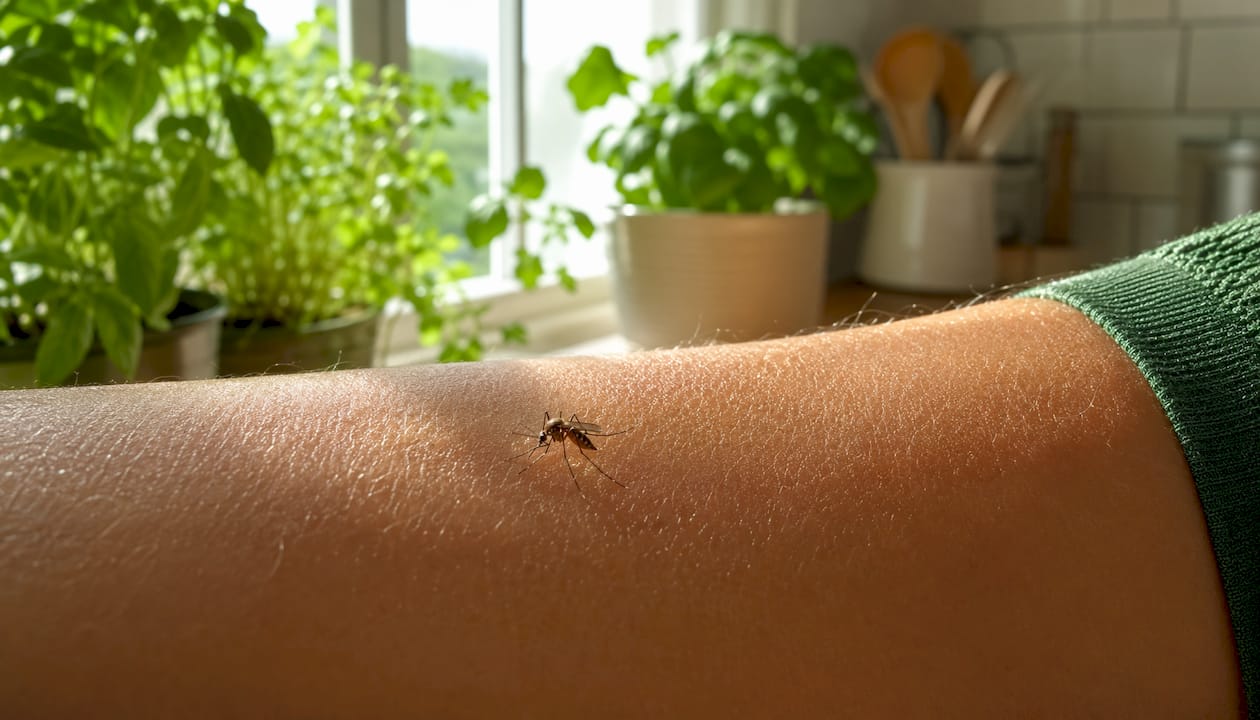
Most of these compounds do not come directly from your sweat glands. They are produced when skin bacteria metabolize the secretions from your sweat and sebaceous glands. Incubated sweat, which has had time for bacterial conversion, attracts mosquitoes more strongly than fresh sweat. The bacteria on your skin are, in a real sense, cooking up the chemicals that make you a target.
| Volatile compound | Chemical class | Mosquito attraction role |
|---|---|---|
| Butyric acid | Carboxylic acid | High attractiveness in An. gambiae |
| Isobutyric acid | Carboxylic acid | Elevated in highly attractive individuals |
| Isovaleric acid | Carboxylic acid | Associated with increased biting preference |
| Acetoin | Methyl ketone | Skin microbe-generated; linked to high attractiveness |
| Lactic acid | Hydroxy acid | Detected by long trichoid sensilla on antennae |
| Ammonia | Inorganic compound | Synergizes with carboxylic acids for An. gambiae |
| Eucalyptol | Monoterpenoid | Enriched in less-attractive individuals |
Research conducted under naturalistic semi-field conditions in Zambia found that highly attractive individuals had whole-body odor profiles enriched with butyric acid, isobutyric acid, isovaleric acid, and acetoin. The least-preferred individuals had odor profiles depleted of carboxylic acids and enriched with eucalyptol, a compound associated with repellency.
- Skin microbiota composition, not hygiene alone, determines which volatile acids you produce
- Pregnancy, metabolic state, and certain infections shift volatile profiles, altering attractiveness
- Perfume and soap can temporarily mask some volatiles but do not change the underlying bacterial community driving production
The antenna is the primary organ for detecting these skin volatiles, specifically through long trichoid sensilla that house olfactory receptor neurons sensitive to lactic acid, ammonia, and related compounds. The labella at the tip of the proboscis also responds to a small set of skin volatiles, adding a secondary layer of chemical sampling even before the mosquito decides to bite.
Pro Tip: If you want to understand why your skin’s lactic acid production makes you more detectable to mosquitoes, the connection runs through your skin microbiome, not just how much you sweat.
How heat and vision guide mosquitoes in for the final approach
Once CO2 and skin odors have pulled a mosquito within about a meter of you, body heat takes over as the dominant guide. Your skin surface sits at roughly 34°C, and that warmth radiates outward as thermal infrared energy. Aedes aegypti can detect this radiation at distances of up to 0.7–0.8 meters, making it a precise intermediate-range cue.
Closer still, within about 10 centimeters, convection heat and humidity become the primary signals. Air temperature equilibrates with the surrounding environment within that narrow band near skin, so the warmth and moisture you radiate only become detectable at very close range. The antenna near its distal tip handles convection heat sensing, while humidity detection works in tandem to guide the mosquito’s final hover before landing.
- ️ Thermal infrared: detected at 0.7–0.8 meters via specialized receptors including Ir21a
- Humidity: synergizes with heat to trigger hovering at 6–8 centimeters from skin
- ️ Visual contrast: mosquitoes prefer dark, high-contrast objects, especially when CO2 is present
- Color preference: Ae. aegypti favors cyan, orange, and red; Culex quinquefasciatus prefers blue and red; Anopheles stephensi is most attracted to black and red
Visual cues play a more nuanced role than many people expect. Color and contrast can induce landing behavior even without CO2, but CO2 shifts the mosquito’s attention from visual cues toward thermal ones, helping it prioritize the warmest, most odor-rich target. When heat and visual cues are both present, mosquitoes still prefer warmed dark objects, but only when those objects show high contrast against the background.
| Cue type | Range | Sensory organ | Key finding |
|---|---|---|---|
| Thermal infrared | 0.7–0.8 meters | Ir21a receptor | Lost in Ir21a knockouts |
| Convection heat | Under 10 cm | Distal antenna | Works with CO2 and odor |
| Humidity | Under 10 cm | Antenna | Enhances heat attraction |
| Visual contrast | Up to 15 meters | Compound eyes | CO2 shifts focus to heat |

The synergy here is what makes mosquitoes so hard to fool. Heat alone, without odor, draws minimal response at naturalistic distances. Vision alone can trigger landing but works far better when CO2 is present. Each cue amplifies the others, and that compounding effect is what makes a warm, breathing, visually distinct human such an irresistible target.
Pro Tip: Wearing light-colored clothing reduces visual contrast and removes one of the cues mosquitoes use to zero in on you, especially effective when combined with a natural repellent that addresses odor and heat cues simultaneously.
Why female mosquitoes are so relentlessly driven to find you
Only female mosquitoes bite. Males feed on nectar and plant sugars, but females need a blood meal to develop their eggs. That reproductive imperative is what drives the persistence and sensory sophistication you experience on a summer evening.
“The female mosquitoes are determined to find blood meals to nourish their eggs. Their tenaciousness would be less of a concern if they were not so highly skilled at sensing humans.” — PMC, The sensory arsenal mosquitoes use to find us
The behavioral sequence a female mosquito follows is orderly and deliberate:
- Activation: A resting mosquito detects CO2 or another cue and shifts into active flight
- Long-range orientation: She tracks upwind along CO2 plumes toward the source
- Mid-range approach: Skin odors and thermal infrared narrow the target
- Hovering: Convection heat and humidity guide her to within centimeters of skin
- Landing: She touches down, using tarsal sensilla on her forelegs to taste non-volatile chemicals
- Probing decision: After sampling skin chemistry, she decides whether to probe for a vein or fly away
That final taste-testing step is often overlooked. Upon landing, mosquitoes use taste sensilla on their legs and the labella of their proboscis to sample ammonium, amino acids, fatty acids, and salts on your skin. Only after this chemical evaluation does she commit to probing. It is a remarkably deliberate process for an insect.
| Sensory organ | Primary function | Cues detected |
|---|---|---|
| Maxillary palps (cpA neuron) | CO2 detection | Exhaled carbon dioxide |
| Antennae (long trichoid sensilla) | Volatile odor detection | Lactic acid, ammonia, carboxylic acids |
| Labella (proboscis tip) | Taste and some volatile sensing | Non-volatile skin chemicals, some volatiles |
| Tarsal sensilla (forelegs) | Post-landing taste | Ammonium, amino acids, fatty acids, NaCl |
Circadian rhythms also shape when females hunt. Anopheles gambiae, the primary malaria vector in sub-Saharan Africa, peaks in host-seeking during the hours flanking midnight, when humans are typically sleeping indoors. Timing your protection accordingly, especially during those late-night hours, addresses the biological window when biting risk is highest.
What the latest research reveals about individual attractiveness and sensory switching
The science of why some people get bitten far more than others has sharpened considerably in recent years. The short answer is that your skin microbiome composition governs the production of specific volatile carboxylic acids, and individuals with high abundances of butyric and isovaleric acid-producing bacteria are consistently more attractive to mosquitoes, regardless of how often they shower or what fragrance they wear.
“Unique skin microbiomes drive the ‘mosquito magnet’ effect by producing specific chemicals attractive to mosquitoes, more than hygiene or perfume.” — PMC, Skin microbiota and mosquito attraction
Beyond microbiome differences, researchers have documented a phenomenon called sensory compensation: when one sensory pathway is blocked or masked, mosquitoes shift reliance to other cues to maintain host-finding accuracy. This sensory switching explains why repellents targeting only a single cue, say odor alone, often show inconsistent results in real-world conditions. The mosquito simply leans harder on heat or visual contrast to compensate.
- Genetic studies confirm that olfactory receptor genes (ORs, OBPs, IRs) vary between individuals and species, shaping both attraction and repellency responses
- Pregnancy, certain infections, and metabolic shifts alter the volatile profile in ways that increase or decrease attractiveness
- Compounds like eucalyptol, found naturally in some individuals’ skin volatiles, correlate with lower mosquito preference
- Multi-modal repellent strategies targeting CO2 detection, skin odor masking, and heat disruption simultaneously outperform single-pathway approaches
Dr. Jeff Riffell’s research at the University of Washington has contributed to understanding how mosquitoes integrate multiple olfactory signals in their brain’s antennal lobe, where CO2 responses modulate visual processing in the optic lobe, effectively coupling host identification with host location. The brain does not process these cues in isolation; it runs them through an integrated decision circuit that weights each signal based on what else is present.
The practical implication is clear: protecting yourself means addressing the full sensory picture, not just one layer of it.
How humidity and moisture detection shape mosquito behavior
Humidity is not just a comfort issue for you on a hot day. It is an active sensory cue that mosquitoes use to confirm they are close to a living, breathing host. Moist air rising from skin signals the presence of a warm-blooded animal, and mosquitoes are sensitive to these gradients at very close range.
Attraction to a warmed surface increases when humidity rises alongside it, and this combination triggers the characteristic hovering behavior mosquitoes display at roughly 6–8 centimeters from skin. Research on Ae. aegypti showed that humidity enhances heat attraction, producing a stronger and more directed approach than heat alone. The two cues work together, not independently.
The sensory receptors responsible for humidity detection in mosquitoes have not been fully identified at the molecular level, but the antenna is the primary site. What is clear is that humidity functions as a confirmation signal rather than a long-range activator. It does not draw mosquitoes from across a yard; it helps them lock onto the precise location of skin once they are already close. Think of it as the final GPS fix in a multi-step navigation system.
How different mosquito species vary in how they find hosts
Not all mosquitoes hunt the same way, and species-specific differences in sensory receptor expression, host preference, and behavioral timing mean that what works as protection against one species may be less effective against another.
Aedes aegypti, the primary vector of dengue, Zika, and chikungunya, is strongly anthropophilic and relies heavily on CO2 to gate its responses to heat and skin odor. Its Gr3 receptor subunit is essential for CO2 detection, and Gr3 knockouts lose long-range attraction to humans. Culex quinquefasciatus, which transmits West Nile virus, shows a different pattern: females land on warmed, odor-baited surfaces even without prior CO2 exposure, making them somewhat less dependent on CO2 as a gating cue.
Anopheles gambiae, the African malaria vector, is among the most human-focused mosquitoes on earth. Among more than 400 Anopheles species, only about 30 feed on humans, and An. gambiae sits at the extreme anthropophilic end of that spectrum. It relies heavily on olfactory cues but also responds to visual cues in low light when human odors are present, a useful adaptation for hunting in dark indoor environments. Its peak activity in the hours around midnight aligns precisely with when humans are most stationary and least defended.
Anopheles arabiensis occupies a more opportunistic position, feeding on both humans and animals depending on availability. This behavioral flexibility reflects a broader principle: mosquitoes can adapt their host preference based on prior experience and host availability, which has real implications for disease transmission dynamics when human populations are protected and mosquitoes shift to animal reservoirs.
Color preference also differs by species. Ae. aegypti favors cyan, orange, and red objects when activated by CO2. Cx. quinquefasciatus prefers blue and red. An. stephensi shows the strongest attraction to black and red. These differences likely reflect adaptations to the visual environments where each species hunts, and they suggest that clothing color choices may matter differently depending on which species is most active in your area.
Protect yourself the natural way with Jeffi

Understanding how mosquitoes find you is the first step toward stopping them. The science is clear: they use a layered system of CO2, skin odors, heat, and visual cues, and the most effective protection addresses more than one of those pathways at once.
Jeffi’s natural mosquito repellent products are Non-GMO Project verified and made with all-natural ingredients designed to work with your skin, not against it. Whether you reach for the whipped body butters, the hand and body lotion, or the sugar scrubs, each product is formulated to help mask the skin cues that make you a target, while keeping your skin feeling nourished and healthy.
✅ All-natural, chemical-free formulas ✅ Non-GMO Project verified ✅ Skin-nourishing ingredients that support your skin’s natural barrier ✅ Designed for the whole family
Explore Jeffi’s full line of body butters and skin care and find the combination that fits your outdoor routine. Your next summer evening deserves to be about laughter, not itch relief.
Key Takeaways
Mosquitoes locate human hosts through a hierarchical, multi-sensory system where carbon dioxide activates the hunt at long range, skin volatiles and heat narrow the approach, and taste confirms the final biting decision.
| Point | Details |
|---|---|
| CO2 is the long-range trigger | Female mosquitoes detect exhaled CO2 from 10–15 meters, activating sensitivity to all other host cues. |
| Skin microbiome drives attractiveness | Bacteria converting sweat into butyric, isobutyric, and isovaleric acids make some individuals consistently more attractive. |
| Heat and humidity confirm close range | Thermal infrared guides approach at 0.7–0.8 meters; convection heat and humidity lock in the target within 10 centimeters. |
| Sensory compensation limits single-cue repellents | When one cue is masked, mosquitoes shift to others, so multi-modal protection outperforms single-pathway approaches. |
| Species differ in sensory priorities | Ae. aegypti requires CO2 to gate heat responses; Cx. quinquefasciatus lands on odor-baited surfaces without prior CO2 exposure. |