

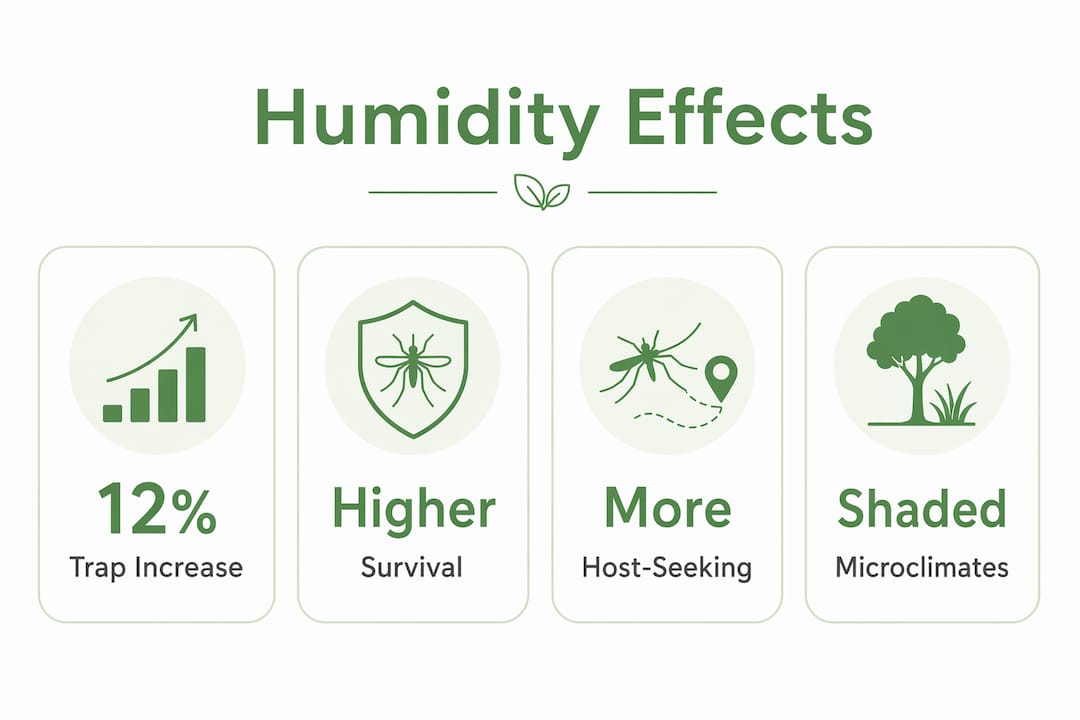
Yes, humidity makes mosquitoes measurably worse in your backyard, and the effect is strong enough to change your evening plans. Field studies show a clear positive correlation between relative humidity (RH) and mosquito trap counts across multiple species. Research from the Canadian Prairies found trap counts rose noticeably for each percentage-point increase in RH, with an estimated 12% more mosquitoes captured per percentage-point increase for one species. Pest-management experts consistently recommend microclimate control as the most practical homeowner response.
Here’s what that means for you tonight:
- ✅ Humidity drives activity: Higher RH keeps adult mosquitoes alive longer, extends their biting hours, and supports egg and larval survival.
- ✅ The threshold matters: Research suggests mosquito survival drops sharply below roughly 40% RH, while the 60–85% range is their comfort zone.
- ✅ One step to try right now: Empty every saucer, bucket, or low spot holding water in your yard. That removes both a breeding site and a local humidity source.
Table of Contents
- How does humidity change mosquito behavior and survival?
- Why humidity never acts alone: temperature and rain change everything
- Where does humidity concentrate in your backyard?
- How do you measure RH in your yard, and what numbers matter?
- Actionable yard and personal steps to lower local humidity and reduce bites
- What does humidity mean for disease risk, and where does the science stop?
- Key Takeaways
- The part most homeowners miss about humidity and mosquitoes
- Natural topical protection for high-humidity evenings
- Useful sources to read next
How does humidity change mosquito behavior and survival?
Humidity affects mosquitoes at every life stage, not just when they’re flying around your patio. At the adult stage, the mechanism is desiccation: mosquitoes lose water through their cuticle, and when RH drops, they dry out and die faster. A pooled survival analysis of Aedes aegypti found that hazard ratios for mortality increase sharply as RH falls from saturation toward lower levels, especially when temperatures are also high.
Eggs and larvae are equally sensitive. Higher RH slows the drying of small water containers, giving eggs more time to hatch and larvae more time to develop. A large-scale surveillance study in Zhejiang Province confirmed that both adult and larval mosquito density increased consistently with rising humidity levels.
By the numbers: In Manitoba field sampling, trap counts increased linearly with RH, with an estimated 12% more mosquitoes captured per percentage-point increase in RH for one species.
Host-seeking behavior also shifts with humidity. Recent research published in Annual Reviews of Entomology notes that humidity sensors guide mosquitoes toward hosts and egg-laying sites, meaning a humid yard is literally a signal that draws them in. Aedes species (the aggressive daytime biters) and Culex species (active at dusk and dawn) both respond to RH, though their exact thresholds differ slightly.
Why humidity never acts alone: temperature and rain change everything
Think of humidity, temperature, and precipitation as three dials that all turn at once. Humidity modifies and is modified by the other two, and including all three in mosquito population models significantly improves predictive accuracy.
Here’s how the combinations play out in a typical backyard:
- ️ Warm, humid evening (75°F+, RH above 70%): Peak risk. Mosquitoes are active, well-hydrated, and host-seeking. This is the scenario that turns a beautiful summer evening into an itchy nightmare.
- ☀️ Hot, dry afternoon (90°F+, RH below 40%): Lower adult activity. Heat accelerates desiccation, and mosquitoes retreat to shaded, humid refuges. Biting pressure drops, but the insects survive in your dense groundcover.
- ️ Heavy rain followed by warm, humid days: Breeding spike. Rain fills containers and low spots; the subsequent humidity slows evaporation and keeps those sites wet long enough for larvae to develop.
One nuance worth knowing: heavy rain alone doesn’t guarantee a mosquito surge. If RH drops quickly afterward and containers dry within 48–72 hours, larval development stalls. The real risk is warm, humid weather that keeps those breeding sites wet for a week or more.
Where does humidity concentrate in your backyard?
Mosquitoes don’t experience your yard the way you do. They find the pockets where ground-level RH stays high even when the rest of the yard feels comfortable. Dense groundcovers like English ivy, Asian jasmine, and liriope trap moisture at soil level and create humid daytime resting zones that sustain adult mosquitoes through the hottest part of the day.
Use this quick checklist on your next yard walk-through:
- Dense groundcovers and low shrubs: Trap moisture, block airflow, and give mosquitoes a cool, humid refuge.
- Potted-plant saucers and low containers: Hold standing water and raise local humidity as water evaporates.
- Foundation planting beds: Irrigation runoff collects here; soil stays wet longer than open lawn.
- Clogged gutters: Standing water plus shade equals a perfect breeding and resting zone.
- Under decks and in shaded corners: Low airflow keeps RH elevated even hours after rain.
Pro Tip: After irrigation or rain, walk your yard within an hour and check every shaded, low-airflow spot. Those are the places where RH stays highest longest, and where mosquitoes will be resting by mid-morning.
How do you measure RH in your yard, and what numbers matter?
Your phone’s weather app reports RH for the nearest weather station, which may be miles away and at a different elevation. For a useful backyard reading, follow these three steps:
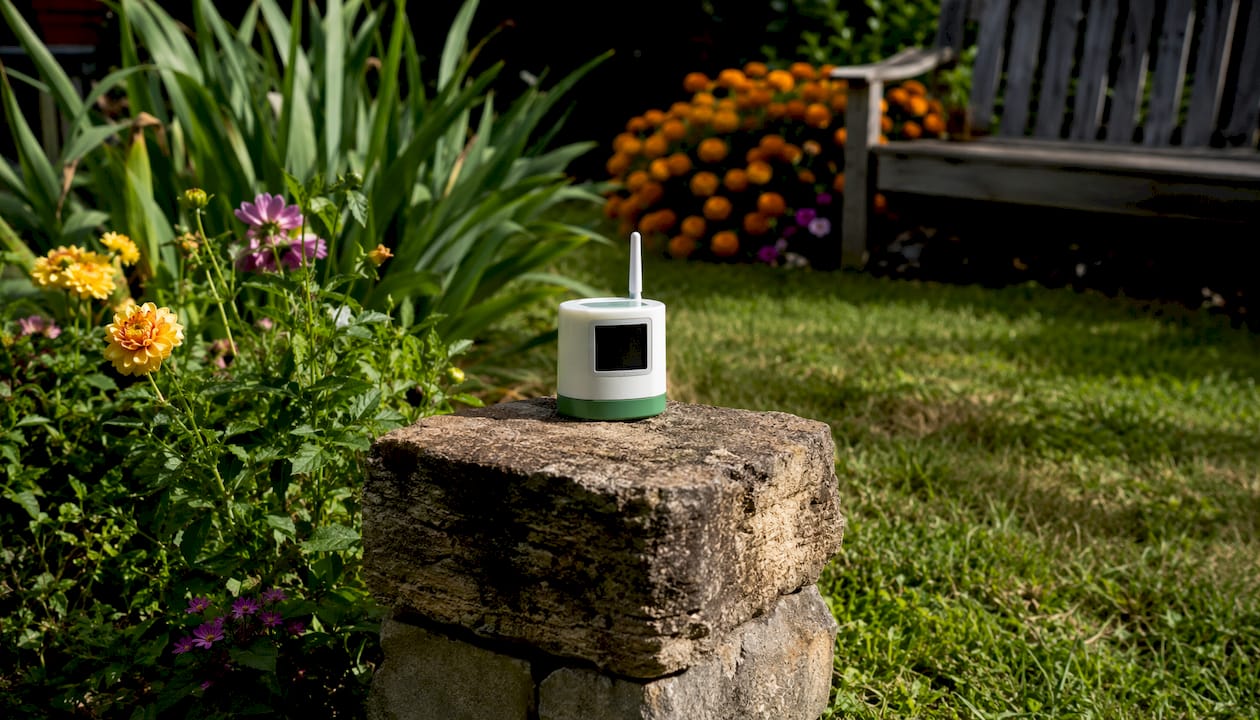
- Place a digital hygrometer (a $10–$20 device at any hardware store) at knee height in the shadiest, most sheltered part of your yard.
- Take readings in the early morning (6–8 AM) and again at dusk (7–9 PM) — those windows reflect the humidity conditions mosquitoes actually experience during peak activity.
- Log readings over several days to spot your yard’s pattern, not just a single snapshot.
Thresholds to watch: RH consistently above 60–70% in your yard’s resting zones signals high mosquito comfort. Research shows that An. gambiae longevity is not substantially affected at RH above 60%, but survival drops sharply below 40%. For practical purposes, if your shaded spots read above 65% at dusk, mosquito pressure will be high.
Wireless sensor nodes (like those from Govee or Inkbird) let you monitor multiple yard zones simultaneously from your phone, which is helpful if you have both sunny and heavily shaded areas. Local weather station data from Weather Underground’s Personal Weather Station network can supplement your readings and help you track seasonal patterns.
Actionable yard and personal steps to lower local humidity and reduce bites
The highest-impact move is reducing the humid refuges where mosquitoes rest and breed. Everything else builds on that foundation.
- Thin dense groundcovers. Remove or heavily prune English ivy, liriope, and similar low-growing plants near patios and seating areas. You don’t have to eliminate them, just open up airflow at ground level.
- Trim hedges and shrubs near patios. Raise the canopy height so air circulates underneath. A hedge that starts at knee height traps far more humidity than one pruned to start at waist height.
- Fix drainage issues. Fill low spots, regrade areas that pool after rain, and clear gutters every spring and fall.
- Remove saucers and standing water. Empty them after every rain or irrigation cycle, not just when you notice them.
- Adjust your irrigation schedule. Water in the early morning (5–7 AM) so beds dry fully by evening. Overwatering raises ground-level RH and extends mosquito comfort hours well into the evening.
- Run an outdoor fan. A simple box fan or patio fan disrupts the humid microclimate around seating areas and makes it harder for mosquitoes to fly and locate you.
- Time your outdoor activities. On high-humidity evenings, mosquitoes can be active earlier and later than usual. Scheduling yard time for mid-afternoon, when RH typically dips, reduces your exposure.
Pro Tip: Switching to drip or soaker hoses delivers water directly to roots with far less surface evaporation than sprinklers, which meaningfully lowers the microclimate RH in planting beds near your foundation.
For personal protection on humid evenings, wear loose, light-colored, long-sleeved clothing (mosquitoes bite through tight fabrics). Pair that with a chemical-free topical repellent for exposed skin, especially when you’re gardening or sitting near dense plantings.
What does humidity mean for disease risk, and where does the science stop?
Humidity’s effect on disease transmission is real but not simple. Higher RH keeps mosquitoes alive longer, which gives viruses more time to replicate inside the mosquito before it bites again. A 2024 study in mSphere found that Aedes aegypti exposed to low humidity showed higher Zika virus infection rates, and dissemination rates peaked at intermediate humidity levels, suggesting the relationship between humidity and virus spread is not linear.
Key caveats to keep in mind:
- Lab vs. field: Controlled humidity experiments don’t fully replicate the variable conditions in a real backyard.
- Species matter: Aedes aegypti and Culex pipiens respond to humidity differently, and disease risk depends on which species are present in your region.
- Temperature confounds everything: Humidity effects on survival are always modified by temperature, making single-factor conclusions unreliable.
The practical takeaway is straightforward: reducing local mosquito abundance lowers both nuisance biting and any possible transmission risk. You don’t need to interpret the research precisely to benefit from acting on it.
Key Takeaways
Controlling the humid microclimates in your backyard is the single most effective way to reduce mosquito activity, biting pressure, and potential disease risk at the same time.
| Point | Details |
|---|---|
| Humidity drives mosquito numbers | Trap counts rose roughly 12% per percentage-point RH increase in field sampling for one species in Manitoba. |
| Critical RH threshold | Mosquito survival drops sharply below 40% RH; the 60–85% range is their comfort zone. |
| Target humid refuges first | Thin dense groundcovers, fix drainage, and remove standing water to cut local RH. |
| Irrigation timing matters | Water at 5–7 AM so beds dry by evening; overwatering extends mosquito activity hours. |
| Jeffi for personal protection | Complement yard controls with Jeffi’s natural, Non-GMO Project verified topical products on exposed skin. |
The part most homeowners miss about humidity and mosquitoes
Most backyard mosquito advice focuses on standing water, and that’s fair. But standing water is only half the story. The other half is the humid air column that surrounds those water sources and extends well beyond them into your dense plantings, under your deck, and along your foundation beds.
What I’d prioritize in a typical U.S. suburban backyard: first, open up ground-level airflow by thinning low plantings near where people sit. Second, shift irrigation to early morning and let beds dry completely before evening. Third, add a patio fan for the nights when humidity is simply too high to control with landscaping alone. Topical protection fills the gap when those steps aren’t enough.
The research on humidity and disease transmission is still developing, and that’s worth acknowledging. But the practical case for microclimate control doesn’t depend on resolving every scientific question. Fewer mosquitoes resting near your patio means fewer bites, full stop.
Natural topical protection for high-humidity evenings
Microclimate control is your primary defense, and topical protection is the personal layer that covers the gaps. On humid evenings when the air stays thick and mosquitoes push past your yard improvements, having a safe, skin-friendly option on hand makes a real difference.

Jeffi’s natural mosquito repellent and skin-care products are Non-GMO Project verified and made with all-natural ingredients, so you’re not trading bug protection for a chemical burden on your skin. The hand and body lotion, whipped body butters, and sugar scrubs are designed for real outdoor use: gardening, evening patios, post-yard-work skin care. Apply to exposed skin before heading out on humid evenings, after pruning those dense hedges, or any time your yard work runs past dusk. Browse Jeffi’s bundles for a ready-made personal protection kit that pairs repellent with skin care in one order.
Useful sources to read next
- PMC7068582 — Humidity and mosquito trap counts: Field study confirming positive correlation between monthly average RH and mosquito counts across multiple species; the foundational evidence for the humidity-activity link.
- Springer — Canadian Prairies mosquito population dynamics: Documents the 12% per-percentage-point RH finding and shows why including humidity improves mosquito population models.
- Springer — Desiccation stress in Aedes aegypti and Ae. albopictus: Pooled survival analysis quantifying how sharply mortality increases as RH falls; the primary source for desiccation physiology.
- PMC3750695 — Humidity in Anopheles gambiae population models: Establishes the ~40% RH survival threshold and shows how incorporating humidity dramatically improves seasonal mosquito population predictions.
- mSphere — Low humidity and Zika virus in Aedes aegypti: 2024 experimental study showing low humidity increases Zika infection rates and affects dissemination; key evidence for the disease-risk section.
- Frontiers in Climate — Meteorological factors and mosquito density in Zhejiang Province: Large-scale surveillance data confirming humidity’s positive correlation with both adult and larval mosquito density.
- Annual Reviews of Entomology — Environmental factors regulating mosquito physiology: Authoritative review covering how humidity sensors guide host-seeking behavior; useful background on the neuroscience of mosquito attraction.
- Allen Pest NWA — Backyard mosquito attractants: Practitioner-level guidance on dense groundcovers, overwatering, and irrigation timing as microclimate humidity drivers.
- Digital hygrometers: Available at hardware stores (Home Depot, Lowe’s) and online for $10–$20; place at knee height in shaded yard zones for the most relevant RH readings. The Weather Underground Personal Weather Station network provides nearby hyperlocal data as a supplement.