

Here’s the fastest path to a bug-free sunset: empty every bit of standing water in your yard, point a fan across your seating area, and apply a skin-friendly repellent to any exposed skin. Do those three things and you’ve covered the biggest reasons mosquitoes find you in the first place. Mosquitoes reach peak activity at dusk, which is exactly when most of us finally sit down to enjoy the evening.
Why stack three fixes instead of grabbing one candle and hoping? Because each method attacks a different vulnerability. Water removal stops mosquitoes from being born nearby. Fans stop the weak fliers that hatched somewhere else from landing on you. Topicals stop the ones that get through anyway. A natural balm like Jeffi’s repellent line works well here since it’s gentle enough for regular, repeated use during long summer evenings.
- Dump standing water in anything that holds it, even a bottle cap.
- Aim a box or pedestal fan across leg level at your seating area.
- Apply a skin-friendly repellent to arms, ankles, and neck before you sit down.
Quick stat: Mosquito activity climbs sharply in the hour before and after sunset, which is exactly why a single spray at noon won’t save your evening.
Key Takeaways
Enjoying a mosquito-free sunset comes down to removing breeding water, disrupting flight with airflow, and applying a skin-friendly repellent, stacked together rather than used alone.
| Point | Details |
|---|---|
| Kill breeding sites weekly | Empty, scrub, or cover any container holding water regularly to stop eggs before they hatch. |
| Use fans as a physical barrier | Aim a fan across leg height at seating areas since mosquitoes are weak fliers and can’t fight the airflow. |
| Set realistic expectations for candles | Citronella candles and torches help close to seating but often fail against heavy mosquito pressure. |
| Choose topicals based on your skin | Match repellent strength to who’s wearing it; natural, DEET-free balms suit kids and sensitive skin. |
| Layer defenses instead of picking one | Combine water removal, yard maintenance, airflow, and topicals like Jeffi’s repellent line for the most reliable results. |
Table of Contents
- Enjoy Backyard Sunset Without Mosquitoes: Start With Standing Water
- What Yard Changes Keep Mosquitoes From Resting Nearby
- How Do Fans Keep Mosquitoes Away From Seating Areas?
- Do Citronella Candles and Torches Actually Work?
- Which Topical Repellent Is Best for Sensitive Skin?
- Should You Add Screens or a Screened Structure?
- Small Timing and Clothing Changes That Cut Bites
- When Should You Call a Pest Control Professional?
- Where Jeffi Fits Into a Layered Mosquito Defense
- Do Mosquito Traps and Zappers Actually Reduce Bites?
- Can Bats, Birds, and Dragonflies Really Control Mosquitoes?
- How Do You Safely Use Outdoor Insecticides and Larvicides?
- Are Mosquito Repellents Safe Around Kids and Pets?
- What Actually Moves the Needle, and What’s Overhyped
- Ready to Add Skin-Friendly Protection to Your Routine?
- Frequently Asked Questions
- Sources
Enjoy Backyard Sunset Without Mosquitoes: Start With Standing Water
Nothing you do tonight matters as much as what you did last weekend with a hose and a bucket. The CDC recommends emptying and scrubbing water-holding containers weekly because mosquito eggs stick to the sides of containers, and rinsing alone won’t dislodge them. A short, regular walk around your property to remove standing water breaks the breeding cycle before it starts.
- Planter saucers: Tip them over or drill a drainage hole.
- Birdbaths: Dump and scrub regularly; refill with fresh water.
- Buckets and toys: Store upside down or under cover when not in use.
- Gutters: Clear leaf debris that traps water after rain.
- Tarps and pool covers: Pull them taut so water can’t pool in the folds.
- Larger fixtures (rain barrels, ponds): Cover with mesh or add a larvicide labeled for that use.
Pro Tip: If you live in a townhouse row or a neighborhood with shared fence lines, ask a neighbor or two to do their water check the same weekend you do yours. Mosquitoes don’t respect property lines, so one uncovered kiddie pool two doors down can undo your whole afternoon of work.
What Yard Changes Keep Mosquitoes From Resting Nearby
Mosquitoes aren’t just hunting for blood. Most of the day, they’re hiding. They prefer cool, shaded, humid pockets, the exact spots dense shrubs and thick mulch create right next to your favorite chair. Opening up those microclimates with airflow and sunlight makes your yard a far less comfortable place for them to wait out the heat, and consistent landscape maintenance produces a real, lasting drop in local mosquito pressure.
- Trim shrubs and dense hedges back from seating areas.
- Raise low tree branches to let light and air reach the ground.
- Thin out mulch beds near patios; mosquitoes love the moisture they hold.
- Improve drainage so soil doesn’t stay soggy after watering or rain.
- Skip thick ground cover directly beside where people sit.
Plants like lavender, basil, and lemon balm add a nice smell to the patio, but treat them as a pleasant bonus, not a defense. Bats and other backyard predators eat plenty of insects too, though that’s an ecological perk rather than a fast fix for tonight’s cookout.
How Do Fans Keep Mosquitoes Away From Seating Areas?
Mosquitoes are surprisingly weak fliers, and that weakness is exactly what a household fan exploits. A steady breeze scrambles the scent trail they use to find you and makes it physically hard for them to hold a flight path toward your ankles. This is the cheapest, most chemical-free tool on this entire list, and most people already own one.
- Seating zone: Angle a box or pedestal fan across leg height, not overhead.
- Food and grill area: A second fan nearby keeps mosquitoes off plates and drinks.
- Power: Battery or solar fans work for spots far from an outlet; corded fans are stronger for daily use.
Pro Tip: Aim low, not high. Mosquitoes usually approach at ankle and knee height, so a fan blasting your face does little compared to one sweeping across the seating zone at leg level. For a one-off party, two rented pedestal fans on either side of the table often beat one big fan in the corner, though the trade-off is more noise and cord management.
Do Citronella Candles and Torches Actually Work?
Citronella candles and tiki torches create a small pocket of protection right around the flame, but they tend to lose that fight fast once mosquito pressure gets heavy or a breeze carries the scent away from your table. They work best placed close to seating and slightly downwind, not scattered around the yard’s edges for decoration.
- Citronella candles: fine for a light evening, weak on a bad mosquito night.
- Tiki torches: add ambiance and modest protection within a few feet.
- Battery or plug-in zone-protection repellers: independent testing shows these hold up better across a full patio-sized area than candles alone.
- Keep open flames away from dry foliage, tablecloths, and low-hanging branches.
- Give guests, especially kids, a few feet of clearance from any flame source.
If you’re hosting more than a handful of people, a proper repeller unit is usually a smarter investment than a dozen citronella candles.
Which Topical Repellent Is Best for Sensitive Skin?
DEET and oil of lemon eucalyptus remain the most studied active ingredients for keeping mosquitoes off skin, but they’re not the right fit for everyone. Trade-offs between chemical strength and skin sensitivity are real, and plenty of people, especially those with kids or reactive skin, want something gentler for nightly use.
- Apply before you walk outside, not after the first bite.
- Cover all exposed skin, not just arms; ankles and necks get missed often.
- Reapply according to the label, especially after sweating or swimming.
- Avoid layering incompatible lotions or sunscreens without checking compatibility first.
Quick stat: Since mosquitoes bite most heavily right around sunset, applying your repellent 15 to 20 minutes before you head outside gives it time to fully cover your skin before the activity spike hits.
Jeffi makes this easier for households who want a Non-GMO Project verified, DEET-free option that still holds up for regular evening use. It’s a solid pick for anyone who wants repellent that doubles as a moisturizer instead of a chemical you tolerate.
Should You Add Screens or a Screened Structure?
Screening gives you the closest thing to a guaranteed mosquito-free zone, at the cost of some open-air feel. It’s worth checking your existing screens first: a torn window or door screen is basically an open invitation.
- Patch or replace torn screens on windows and doors before summer gets going.
- Pop-up screened canopies or dining nets work well for one evening or a single dinner table.
- Screened porches or gazebos cost more upfront but pay off for anyone who sits outside most nights.
- Screening makes the most sense for frequent evening use, large gatherings, or households with babies, elderly relatives, or anyone especially sensitive to bites.
Small Timing and Clothing Changes That Cut Bites
You don’t need to abandon your sunset plans, just adjust a few habits around them. Since dusk is mosquito prime time, shifting dinner 30 minutes earlier or later can matter more than people expect.
- Wear long sleeves and loose, light-colored clothing on heavy mosquito nights.
- Keep repellent on any skin clothing doesn’t cover.
- Swap bright white porch lights for warm or yellow LED bulbs, which attract far fewer insects.
When Should You Call a Pest Control Professional?
If you’ve emptied the water, run the fans, and applied repellent for weeks and you’re still getting swarmed every single night, that’s usually a sign of a breeding source you can’t see, maybe a neighbor’s yard, a storm drain, or a low spot that floods after every rain.
Before hiring anyone, ask what active ingredients they use, how long the treatment lasts, and whether it’s safe around kids and pets once it dries. Ask about follow-up visits too; one spray rarely solves a persistent problem. If a full-yard chemical treatment doesn’t sit right with your household, targeted larvicide tablets in specific wet spots or a screened structure are reasonable middle-ground alternatives.
Where Jeffi Fits Into a Layered Mosquito Defense
Jeffi builds Non-GMO Project verified, all-natural topical repellents and bug-bite relief products specifically for people who want protection without a harsh chemical trade-off. That matters most in a few specific situations: households with young kids who get repellent applied to them almost every summer night, anyone with reactive or easily irritated skin, and families who simply spend a lot of time outside and don’t want to think twice about reapplying something every couple of hours.
- Works as the final layer after water removal, airflow, and yard maintenance are already handling the bulk of the problem.
- Fits naturally into a nightly routine rather than feeling like a one-time treatment.
- Doubles as skin care, so it’s not just a repellent sitting unused in a drawer.
Real proof matters more than marketing copy. This space is reserved for Jeffi’s own test results, customer testimonials, and case studies once available, so readers can see exactly how the product performs over a full season of use.
Do Mosquito Traps and Zappers Actually Reduce Bites?
Traps and zappers promise to thin out the local mosquito population instead of just protecting the people sitting nearby, and that distinction matters when you’re deciding whether one is worth buying. Bug zappers, the classic purple-light devices, mostly attract and kill moths and other harmless insects rather than mosquitoes, which don’t navigate by visible light the way many other bugs do. If your goal is fewer mosquitoes specifically, a zapper is often a disappointing investment.
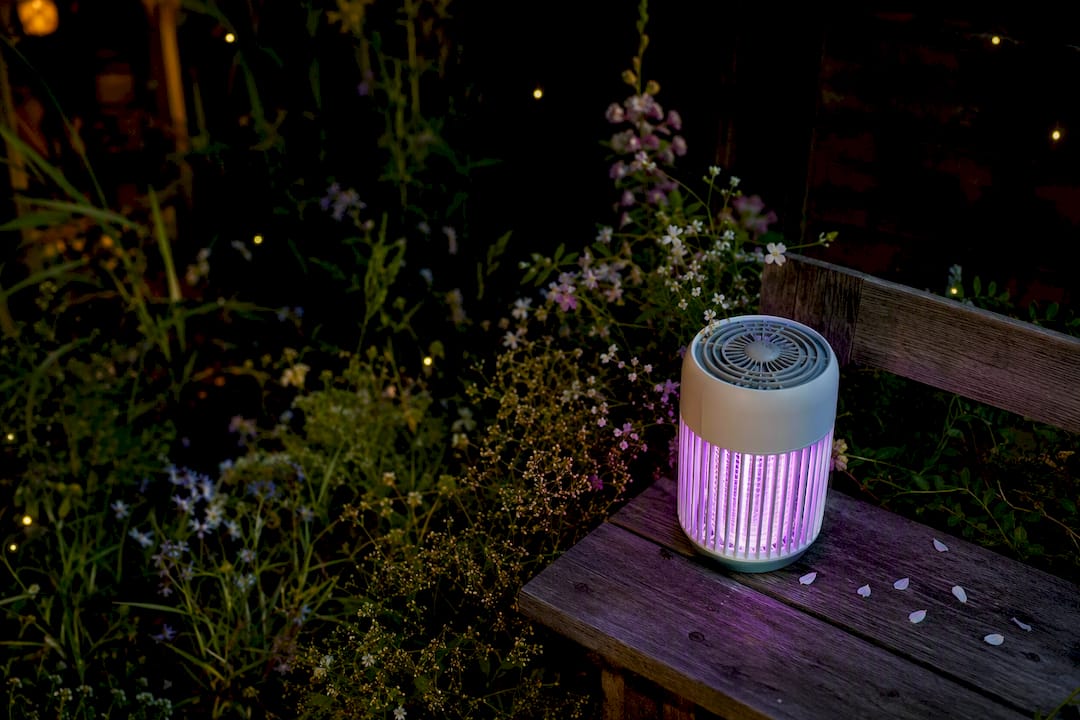
Carbon dioxide and heat-based traps work differently. They mimic the signals mosquitoes use to find a human host, in other words, breath and body warmth, and pull mosquitoes toward a trap instead of your patio. These tend to be more effective at genuinely reducing local mosquito numbers over several days or weeks, especially when run continuously rather than just during your evening cookout. They’re also considerably more expensive than a zapper, and placement matters: put one too close to your seating and you risk drawing mosquitoes toward you before they reach the trap.
For most backyards, a trap works best as a background tool that runs for days or weeks at a time, not a same-night fix. Pair it with the water removal and airflow steps already covered, and you get a compounding effect: fewer mosquitoes hatching, fewer landing on you, and fewer flying around the yard overall by the time the season peaks.
Can Bats, Birds, and Dragonflies Really Control Mosquitoes?
Encouraging natural predators is one of the more satisfying long-term moves you can make, even if it won’t save tonight’s dinner. Bats are the headline example, and research on their feeding habits backs up their reputation as heavy insect eaters, though a single bat house won’t clear a heavily infested yard by itself. Think of bats as part of the ecosystem doing background work over a season, not an on-demand solution.
Dragonflies are an underrated ally. Both nymphs (which live in water) and adults eat mosquitoes in large numbers, and a small backyard pond with clean, circulating water can attract them naturally. Birds like purple martins and swallows also feed on flying insects, and a few birdhouses placed away from your main seating area can encourage them to stick around.

The catch with all of these: they thin out the general population over weeks and months, not the specific mosquitoes buzzing around your ankles this evening. Treat predator-friendly landscaping as a seasonal investment that works alongside your water removal and fan setup, not a replacement for either one.
How Do You Safely Use Outdoor Insecticides and Larvicides?
Insecticides and larvicides solve different problems, and mixing them up wastes money and effort. Larvicides target mosquito larvae in standing water you can’t easily drain, like a decorative pond, a rain barrel, or a low spot that floods after every storm. Products labeled for larvicide use, often containing Bti (a naturally occurring bacterium), are generally considered safe for ponds with fish and for water features near pets, but always read the label for your specific situation.
Adulticide sprays, the barrier treatments that kill flying mosquitoes on contact, work differently and carry more restrictions. Timing matters here: the EPA’s guidance on integrated mosquito control points out that spraying without addressing breeding sites first is far less effective, since new mosquitoes simply replace the ones killed. Apply barrier sprays in the early morning or evening when pollinators like bees are less active, and avoid spraying directly on flowering plants.
Whatever product you choose, follow the label’s re-entry time, the window you should keep kids and pets off treated grass, without exception. If you’re not confident reading application rates or mixing ratios correctly, that’s a reasonable moment to bring in a professional rather than guess.
Are Mosquito Repellents Safe Around Kids and Pets?
Not every product on this list is appropriate for every member of your household, and that’s worth sorting out before dusk rather than during it. DEET-based repellents are generally considered safe for children over two months old at appropriate concentrations, but many parents prefer to avoid stronger formulations on young or sensitive skin, which is exactly where a natural, DEET-free balm earns its place in the routine.
Pets need separate consideration entirely. Never apply human insect repellent directly to a dog or cat, since ingredients safe for people can be toxic to animals, especially cats, who groom themselves and ingest whatever is on their fur. Citronella candles and torches are generally fine to have nearby, but keep pets from chewing on or knocking over anything with an open flame.
Larvicides and barrier sprays deserve the same caution around pets as around kids: keep animals off treated areas until the label’s re-entry period has passed, and store any concentrated product well out of reach. If you’re using a plug-in or battery repeller device, check that it’s rated for enclosed outdoor spaces where a curious dog or toddler might get close to it.
The safest household approach usually layers a low-risk option, fans, water removal, screening, as the base, then adds a topical repellent chosen specifically for the most sensitive person using it that night.
What Actually Moves the Needle, and What’s Overhyped
Most mosquito advice online treats every method as equally important, which isn’t true and sets readers up for frustration. Standing water removal and airflow do the heaviest lifting of anything on this list, yet they’re often buried under flashier advice about ultrasonic gadgets and citronella plants that sound appealing but rarely hold up outdoors. If you only have twenty minutes this weekend, spend it checking for standing water and pointing a fan at your chair, not shopping for a new device.
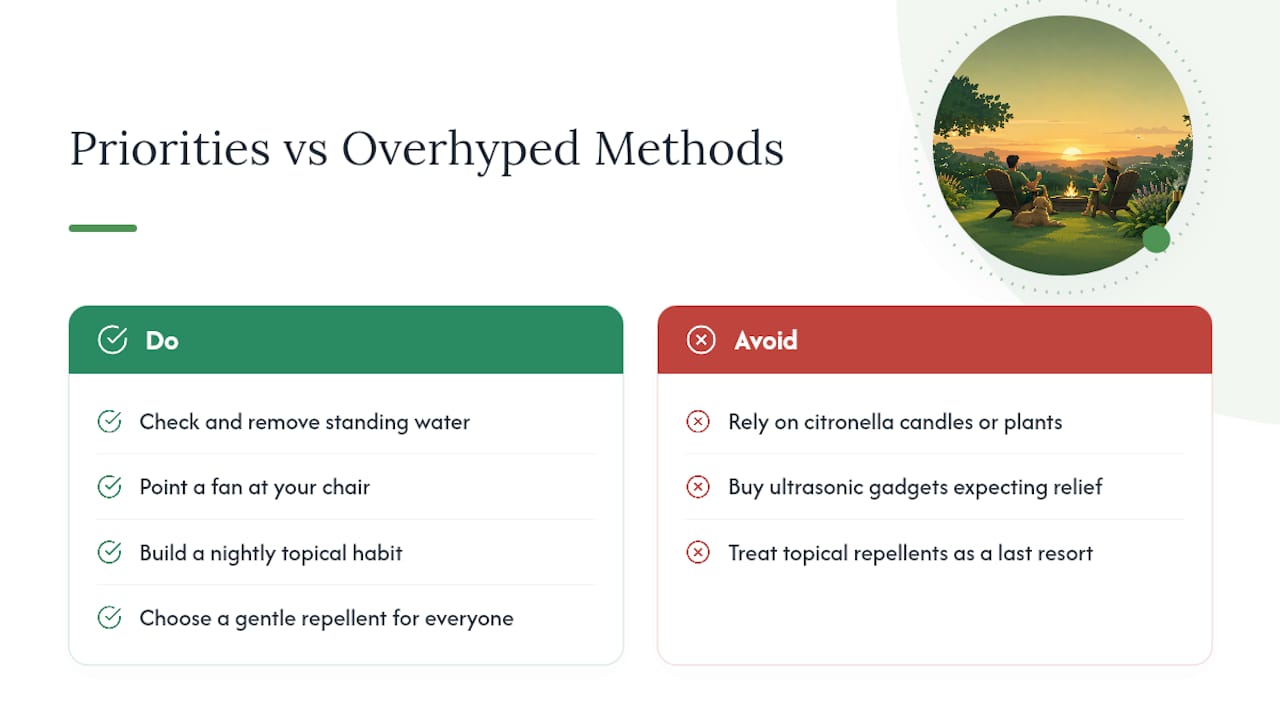
The conventional wisdom oversells single solutions. A citronella candle marketed as “mosquito protection” creates a small pocket of relief at best, and plenty of buyers expect it to clear a whole patio. Topical repellents get treated as a last resort instead of a first-line tool, which is backward for households with kids or sensitive skin who need something they’ll actually use every single evening without hesitation.
What should you prioritize first? Fix the water and airflow problems this weekend, because they’re free or nearly free and they compound over the whole season. Then build a nightly topical habit with something gentle enough that nobody in the house avoids it. A natural option like Jeffi’s repellent line fits that second step well, precisely because comfort determines whether a repellent gets used at all.
Ready to Add Skin-Friendly Protection to Your Routine?
Fans, water removal, and yard trims handle the heavy lifting, but the last mile, keeping mosquitoes off your actual skin, is where most repellents force an unpleasant trade-off between strong chemicals and comfort. Jeffi skips that trade-off. Its Non-GMO Project verified, all-natural balms and roll-ons are built for nightly use on exposed skin, including on kids and anyone with sensitive or reactive skin, without the sticky, chemical feel that makes people skip reapplying halfway through the evening.

If bites do slip through despite your best setup, Jeffi’s bug-bite relief lotions calm the itch fast, so one missed spot doesn’t ruin the rest of your night. And if you’re restocking your whole outdoor skin-care routine, the whipped body butters pair well with repellent for after-sun care once the sun goes down. Browse Jeffi’s full lineup of natural mosquito repellent and skin-care products and pick the option that matches how sensitive your household’s skin actually is, then keep it by the back door so it’s part of your routine before you ever step outside.
Frequently Asked Questions
What’s the single fastest way to enjoy a backyard sunset without mosquitoes? Empty any standing water, run a fan across your seating area, and apply a skin-friendly repellent before you sit down. These three steps address the biggest reasons mosquitoes reach you at dusk.
Why are mosquitoes worse right at sunset? Mosquitoes hit peak activity during dusk and early evening, which lines up almost exactly with prime backyard hangout time.
Do citronella candles really keep mosquitoes away? They help in a small radius close to seating but tend to lose effectiveness in heavier mosquito pressure or windy conditions. A zone-protection repeller device generally holds up better across a full patio.
Is a natural repellent as effective as DEET? Natural, DEET-free balms trade some raw chemical strength for skin comfort, making them a strong fit for kids, sensitive skin, or anyone who wants to reapply nightly without irritation.
How often should I check my yard for standing water? Once a week, minimum. That matches the breeding cycle mosquitoes need to go from egg to biting adult, so weekly checks break the cycle before it starts.
Sources
The CDC’s mosquito control at home guidance covers the standing-water basics that every backyard routine should start with. The EPA’s integrated mosquito control guidance explains why stacking methods outperforms relying on any single tactic. For device-specific buying advice, Wirecutter’s mosquito control device reviews break down which repellers and traps actually hold up in real outdoor testing.
- Mosquito Control at Home | CDC
- Success in mosquito control: integrated approach | EPA
- The 5 Best Mosquito Control Devices of 2026 | Wirecutter
- A guide to mosquito repellents from DEET to gin and tonic | NPR