

Both EPA-registered DEET and picaridin are safe and effective when used as labeled. For most people, picaridin is better tolerated on skin, while DEET remains the longer-tested option for high-risk, long-duration exposures. Here is what the evidence actually says:
- ✅ Both are CDC and EPA approved. The CDC Yellow Book lists DEET and picaridin among recommended EPA-registered repellents and considers both safe when used according to label directions, including for pregnant and breastfeeding women.
- ✅ Picaridin has a favorable tolerability record. A poison-control data review found that 92.9% of picaridin exposures were managed without referral to a healthcare facility, and picaridin exposures were uncommon overall.
- ✅ DEET’s rare severe events are almost always tied to misuse. The ATSDR documents that DEET carries low health risk when used correctly; serious reactions are linked to excessive application or ingestion, not typical use.
- ⚠️ Important exceptions: Neither repellent should be used on infants under two months old. DEET should not exceed 30% concentration for children. Always follow label instructions.
Key Takeaways
Both EPA-registered DEET and picaridin are safe for typical use when applied as directed; picaridin is generally better tolerated on skin, while DEET offers the longest field-tested track record for high-risk, extended exposures.
| Point | Details |
|---|---|
| Both repellents are EPA-approved | CDC and EPA consider DEET and picaridin safe and effective when used per label, including during pregnancy. |
| Match concentration to exposure time | 10% products provide protection for a couple of hours; 20–30% products extend protection to multiple hours. |
| Picaridin is gentler on skin and gear | Picaridin causes fewer irritation reports and does not damage plastics or synthetics the way DEET can. |
| Children and special populations | Neither repellent is for infants under 2 months; keep DEET at or below 30% for children. |
| Jeffi offers DEET-free alternatives | Jeffi’s natural repellent balms and roll-ons suit lower-exposure, everyday outdoor use for skin-conscious families. |
Table of Contents
- How do DEET and picaridin compare side by side?
- How repellents actually protect you
- How long does protection actually last?
- What are the real safety risks of each repellent?
- Guidance for children, pregnancy, and breastfeeding
- How to apply repellents safely and effectively
- How to choose between DEET and picaridin for your situation
- What the research and surveillance data actually show
- Why safe use matters and why we offer DEET-free options
- Jeffi’s natural, DEET-free alternatives for skin-conscious families
- Sources
How do DEET and picaridin compare side by side?
At comparable concentrations, DEET and picaridin deliver similar protection times against mosquitoes and ticks. The practical differences come down to skin feel, material safety, and tolerability.
| Feature | DEET | Picaridin |
|---|---|---|
| Safety/toxicity | Low risk when used as directed; rare severe events linked to overuse or ingestion | Low risk; minor effects dominate poison-control reports |
| Mosquito protection | Excellent | Excellent |
| Tick protection | Excellent | Excellent |
| Fly/chigger protection | Good | Good |
| Skin tolerability | Can cause irritation; oily, strong odor | Generally better tolerated; non-greasy, nearly odorless |
| Effect on plastics/synthetics | Can damage plastics, rayon, spandex, leather | Does not damage most plastics or synthetics |
| Pregnancy/breastfeeding | Acceptable when used as directed (CDC/EPA) | Acceptable when used as directed (CDC/EPA) |
| Children | Not for infants under 2 months; max 30% for kids | Not for infants under 2 months; generally well tolerated |
| Reapplication | Follow label; higher concentration = longer interval | Follow label; similar interval at comparable concentration |
Three practical decision cues:
- If you have sensitive skin or dislike greasy residue, picaridin is the more comfortable choice.
- If you are heading into a high-risk disease area for an extended day outdoors, DEET at around 20–30% offers a long protection window supported by extended use studies.
- If you are carrying gear with plastic buckles or wearing synthetic fabrics, picaridin avoids the material-damage risk that DEET carries.
How repellents actually protect you
Repellents are not insecticides. They do not kill mosquitoes or ticks. Instead, they work by masking the chemical signals, like carbon dioxide and skin odors, that insects use to locate a host. That distinction matters for how you think about safety: you are applying a chemical that confuses insects, not one designed to be toxic to them.
DEET (N,N-diethyl-meta-toluamide) has been in use since the 1940s and remains one of the most studied repellent compounds in the world. Picaridin (KBR 3023, also called icaridin outside the U.S.) was developed later and has been widely used in Europe and Australia for decades before gaining broad U.S. availability.
Key chemistry points:
- Both compounds work on insect olfactory receptors, not through contact toxicity.
- Formulation matters as much as active ingredient. Lotions and pump sprays tend to spread more evenly than aerosols, reducing the chance of over-application.
- Concentration determines duration, not potency. A 10% picaridin product is not “weaker” in the sense of being less effective per molecule; it simply wears off sooner than a 20% product.
The EPA RMPP chapter on insect repellents notes that picaridin tends to be better tolerated and does not damage plastics, which DEET is known to do.
How long does protection actually last?
Protection time depends on concentration, sweat, water exposure, and formulation. Higher concentrations extend the interval between applications, not the strength of protection in the first hour.

| Concentration | Typical Protection Duration | Notes |
|---|---|---|
| DEET 10% | ~2 hours | Suitable for brief outdoor activity |
| DEET 20–30% | ~4–6 hours | Recommended for extended outdoor exposure |
| Picaridin 10% | ~2 hours | Comparable to DEET 10% |
| Picaridin around 20% | several hours | Comparable to DEET at similar concentrations |
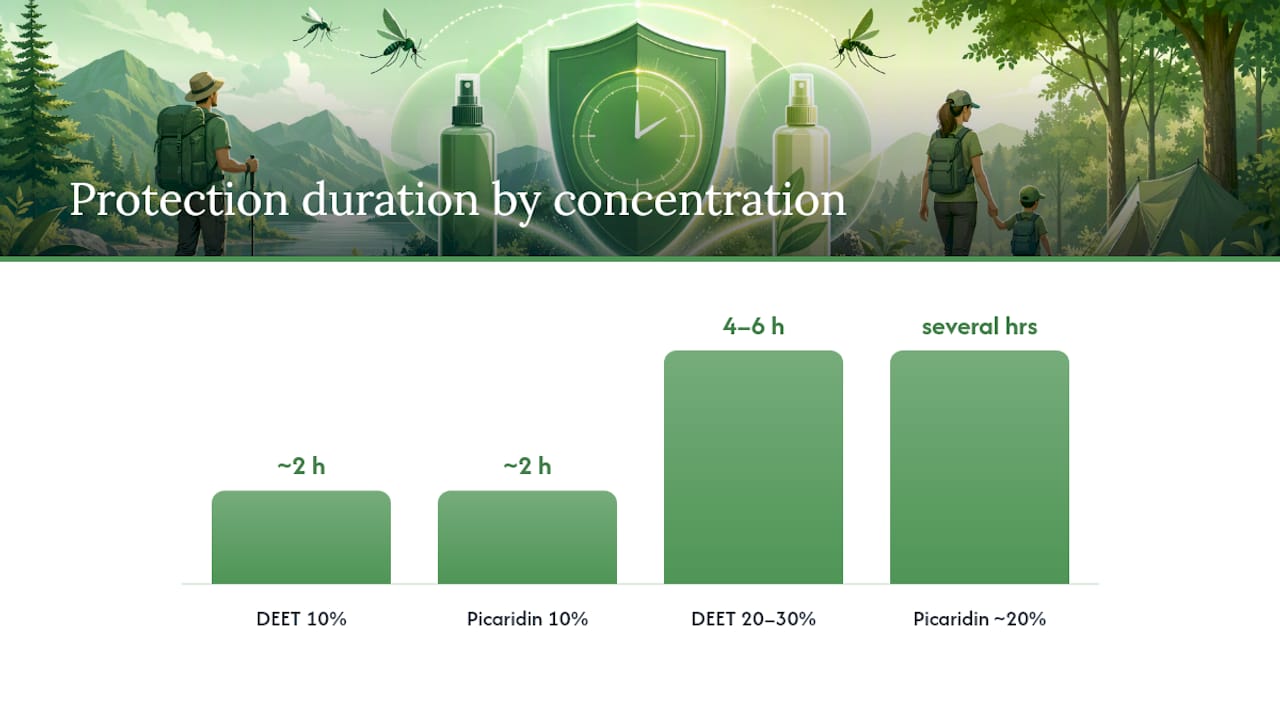
MotherToBaby’s review confirms that DEET (15–30%) and picaridin (10–20%) can both provide multi-hour protection at similar concentration ranges. The EPA guidance is clear: higher concentrations generally provide longer protection, and you should never reapply more frequently than the label allows.
Sweat, swimming, and heavy rain all shorten effective protection time. Sustained-release or microencapsulated formulations can extend duration somewhat, but the label’s reapplication interval is still the governing rule.
Pro Tip: Match your repellent concentration to your planned time outdoors. Choosing the right concentration up front means fewer applications and less total exposure.
What are the real safety risks of each repellent?
Both repellents have reassuring safety profiles when used correctly. The risks that do exist are almost entirely tied to misuse.
Common, minor effects for both include skin irritation, eye irritation if sprayed near the face, and occasional rash. These are manageable and typically resolve after washing the product off.
Rare, severe events are a different story. The ATSDR ToxFAQs for DEET document rare neurologic events, but these are almost exclusively associated with excessive application over large body areas, use on broken skin, or accidental ingestion. The EPA RMPP confirms that picaridin is generally better tolerated and that serious reactions with either compound are uncommon in typical use.
Surveillance data perspective: A review of U.S. poison-control records found that picaridin exposures were uncommon and that 92.9% of picaridin cases were managed without referral to a healthcare facility. The vast majority of reported effects were minor.
Material interactions are one area where DEET stands apart. DEET can dissolve or damage plastics, rayon, spandex, and leather. Picaridin does not carry this risk, making it the better choice when you are handling gear, camera equipment, or wearing synthetic athletic fabrics.
Practical cautions for both:
- Avoid applying to broken, irritated, or sunburned skin.
- Do not spray directly on the face; apply to hands first, then spread carefully.
- Wash repellent off with soap and water when you return indoors.
- Store products away from children.
Guidance for children, pregnancy, and breastfeeding
Parents and pregnant readers often have the most questions about insect repellent safety, and the guidance here is more reassuring than many people expect.
For children:
- Neither DEET nor picaridin should be used on infants younger than two months old.
- The American Academy of Pediatrics (AAP) advises that DEET products used on children should not exceed 30% concentration.
- Apply repellent to children yourself rather than letting them apply it. Keep it away from their hands, eyes, and mouth.
- Avoid applying to cuts, wounds, or irritated skin.
- Wash treated skin with soap and water after coming indoors.
For pregnancy and breastfeeding:
The CDC and EPA both state that EPA-registered DEET and picaridin are acceptable for use during pregnancy and breastfeeding when applied as directed. MotherToBaby’s review notes that only low amounts are expected to be absorbed systemically when repellents are used as labeled. Washing the product off after returning indoors reduces any residual exposure.
Key reassurance for parents: When disease risk is real, using an EPA-registered repellent correctly is the primary safety action. The risk of mosquito-borne illness during pregnancy, including Zika and West Nile virus, outweighs the low risk of properly applied repellent.
The CDC prevention guidance also recommends non-chemical protective measures alongside repellents: long sleeves, pants, and window screens all reduce bite exposure without any chemical contact.
How to apply repellents safely and effectively
Getting protection right is mostly about following the label and a few common-sense steps.
- Apply sunscreen first. If you are using both sunscreen and repellent, apply sunscreen first and let it absorb, then apply repellent on top. Do not use combination sunscreen-repellent products; sunscreen often needs reapplication more frequently than repellent.
- Apply to exposed skin only. Repellent on covered skin adds no protection and increases unnecessary exposure.
- Use sparingly. A thin, even layer is enough. More product does not mean more protection.
- Avoid broken or irritated skin. Both DEET and picaridin can cause increased irritation on compromised skin barriers.
- Keep it away from eyes and mouth. Spray into your hands first, then apply to the face. Never spray aerosols directly at the face.
- Treat clothing with permethrin separately. EPA guidance is explicit: permethrin is for clothing and gear only, never for skin. Let permethrin-treated clothing dry fully before wearing.
- Wash off when you come inside. Soap and water remove residual repellent and reduce cumulative exposure.
If accidental exposure happens:
- Skin: Wash the area thoroughly with soap and water.
- Eyes: Rinse with clean water for 15–20 minutes.
- Ingestion: Call Poison Control immediately at 1-800-222-1222. Do not induce vomiting unless directed.
- Excessive application with symptoms: Seek medical attention and bring the product label.
Pro Tip: *Choose your concentration based on how long you plan to be outside, not on how intense the bug pressure feels.
How to choose between DEET and picaridin for your situation
The safety profiles of DEET and picaridin are close enough that your choice often comes down to practical preferences and specific circumstances.
- 🌿 Sensitive skin or skin conditions: Picaridin wins. Its non-greasy, nearly odorless formula causes fewer reports of irritation and is generally better tolerated across skin types.
- 🧒 Young children: Either is acceptable per CDC/EPA guidance, but picaridin’s tolerability advantage and lack of plastic-damaging properties make it a practical first choice for families. Keep DEET at or below 30% if you use it.
- 🤰 Pregnancy: Both are considered acceptable when used as directed. Picaridin’s lower irritation profile may feel more comfortable, but either EPA-registered option is supported by public health guidance.
- 🦟 High-risk travel or disease-endemic areas: DEET at 20–30% has the longest track record in high-transmission settings. Both are effective, but DEET’s decades of field data give some clinicians added confidence in extreme conditions.
- 🎒 Gear-heavy outdoor activities: Picaridin is the clear choice when you are handling plastic-buckled packs, camera equipment, or wearing synthetic performance fabrics. DEET can damage those materials.
- 🌆 Short urban evening outings: A 10% product of either type is sufficient for a two-hour outdoor dinner or evening walk.
- 🌍 Environmental considerations: Both compounds have some environmental persistence, and neither should be applied near water sources. Non-chemical measures, like long clothing, window screens, and eliminating standing water, should be your first line of defense when disease risk is low.
What the research and surveillance data actually show
The evidence base for both repellents draws from decades of poison-control surveillance, toxicology reviews, and pregnancy safety monitoring, not just short-term lab studies.
Poison-control surveillance is one of the most useful real-world safety signals available. The PubMed poison-control review found that picaridin accounted for a small share of repellent-related exposures in the U.S., and that 92.9% of those cases were managed without any healthcare facility referral. DEET exposures are more numerous simply because DEET has been on the market longer and is more widely used, but serious outcomes remain rare in both categories.
Pregnancy safety data is limited by the ethical constraints on clinical trials in pregnant populations, but the available evidence is reassuring. MotherToBaby’s systematic review concludes that systemic absorption is low when either repellent is used as directed, and no pattern of increased birth defects or adverse pregnancy outcomes has been identified.
The CDC and EPA state that both DEET and picaridin are safe and effective when used according to label instructions, and this guidance explicitly includes pregnant and breastfeeding women. Public health authorities prioritize disease prevention: in areas with active mosquito-borne disease transmission, the risk of not using an effective repellent outweighs the low risk of proper repellent use.
How to read the evidence: Surveillance data and systematic reviews were prioritized here over individual case reports, because case reports cannot establish causation and often involve misuse scenarios. The ATSDR ToxFAQs and EPA RMPP chapter both represent expert synthesis of the broader evidence base, not single-study conclusions.
Why safe use matters and why we offer DEET-free options
At Jeffi, we have read the same evidence you just did, and we respect it. DEET and picaridin are both EPA-registered, both backed by solid surveillance data, and both acceptable choices when used correctly. We are not here to tell you that EPA-registered repellents are dangerous, because the evidence does not support that.
What we do know is that a meaningful number of people, including parents of young children, people with sensitive or reactive skin, and those who simply prefer to minimize synthetic chemical contact, want an alternative that fits their lifestyle. That preference is valid, and it is the reason Jeffi exists.
The honest framing is this: if you are traveling to a malaria or Zika-endemic region, use an EPA-registered repellent. Full stop. But if you are spending a summer evening on your back porch, attending an outdoor wedding, or looking for a daily-use option that feels good on your skin, a well-formulated natural repellent is a reasonable choice for lower-exposure scenarios.
Weighing disease-risk prevention against product preferences is a personal decision. We think you deserve clear information to make it.
Jeffi’s natural, DEET-free alternatives for skin-conscious families
If you have read this far and you are leaning toward a lower-chemical option for everyday outdoor use, Jeffi’s DEET-free mosquito repellent balms and roll-ons are formulated with natural ingredients and are Non-GMO Project verified. They are designed for people who want protection without the oily residue, synthetic fragrance, or plastic-damaging chemistry that comes with conventional repellents.

Jeffi also offers bug bite relief lotions and ointments for after-exposure care, along with skin-nourishing whipped body butters that help restore your skin barrier after a day outdoors.
One important note: Jeffi’s natural repellents are positioned for lower-exposure, everyday scenarios. For travel to disease-endemic regions or prolonged high-risk exposure, an EPA-registered DEET or picaridin product remains the public-health-recommended choice. Always read product labels and consider a patch test before first use. Browse Jeffi’s full natural repellent and skin-care range at Jeffi and find the option that fits your outdoor routine.
Sources
- Mosquitoes, Ticks, and Other Arthropods | CDC Yellow Book™
- Poison center data review (PubMed)
- Insect Repellents - MotherToBaby | NCBI Bookshelf
- Recognition and Management of Pesticide Poisonings, 6th ed. — Chapter 14: Insect repellents (EPA RMPP)
- DEET (N,N-diethyl-meta-toluamide) ToxFAQs | ATSDR (CDC)
This article provides general information only and is not a substitute for professional medical advice. Confirm current guidance with the CDC, EPA, or a qualified healthcare provider before making repellent choices for specific medical situations.