

For fast, natural insect bite relief, Jeffi Bug Bite Relief Balm is the recommended choice. It soothes itch, calms swelling, and forms a protective barrier that discourages scratching — all without synthetic chemicals or DEET. It carries Non-GMO Project verification, aligns with American Academy of Dermatology (AAD) guidance on topical anti-itch and barrier-forming care, and follows the same clean-first, soothe-second sequence that Mayo Clinic recommends for home bite treatment.
At a glance, Jeffi Bug Bite Relief Balm:
- ✅ Soothes itch quickly with natural anti-inflammatory botanicals
- ✅ Reduces localized swelling and pain
- ✅ Forms a protective barrier to stop the itch-scratch cycle
- ✅ Non-GMO Project verified, DEET-free, and made with a transparent ingredient list
Key Takeaways
A Non-GMO Project verified, all-natural bug bite balm that combines anti-inflammatory botanicals with a beeswax barrier is the most effective topical approach for soothing mild insect bites at home.
| Point | Details |
|---|---|
| Clean before you apply | Wash the bite with soap and water first — skipping this step is the main cause of secondary infection. |
| Barrier + botanicals together | Look for beeswax or shea paired with calendula or aloe; that combination breaks the itch-scratch cycle. |
| Patch test every new balm | Apply to your wrist 24 hours before using on a bite, especially for children or sensitive skin. |
| Match form to situation | Roll-ons suit outdoor carry; jars suit home use; bundles offer the best per-ounce value for families. |
| Jeffi Bug Bite Relief Balm | Non-GMO verified, DEET-free, available in balm and roll-on; the recommended all-natural option for fast itch relief. |
Table of Contents
- What does a good bug bite balm actually do?
- Which ingredients in a natural bug bite cream actually work?
- How to treat a bug bite before and after applying balm
- How to choose the right anti-itch balm for your needs
- Why natural balms work and what the safety evidence says
- Jeffi’s formulation philosophy
- Ready to try Jeffi Bug Bite Relief Balm?
- Sources
What does a good bug bite balm actually do?
A quality all-natural bug bite balm works on three levels at once: it calms the itch, reduces localized inflammation, and physically protects the skin so you stop scratching. Scratching feels satisfying for about three seconds, then it makes everything worse — it breaks the skin, invites bacteria, and prolongs healing.
Jeffi Bug Bite Relief Balm delivers all three functions in a clean, DEET-free formula:
- 🌿 Anti-itch action — natural botanicals interrupt the histamine-triggered itch signal at the skin surface
- 🌿 Anti-inflammatory — plant-based actives reduce redness and swelling around the bite
- 🌿 Protective barrier — beeswax and skin-nourishing oils seal the area so scratching becomes less tempting
- 🌿 Ingredient transparency — every ingredient is listed, Non-GMO Project verified, and free of hidden synthetic additives
Jeffi offers the balm in multiple forms: a traditional balm/ointment for targeted application, and a roll-on for no-touch convenience. Each form carries the same natural formula.
Pro Tip: A topical balm is your first line of defense for mild bites. If you’re dealing with widespread hives, a bee sting with rapid swelling, or a bite that covers a large area, layer in an oral antihistamine (like cetirizine) or a low-strength hydrocortisone cream alongside the balm — and call your doctor if symptoms escalate.
Which ingredients in a natural bug bite cream actually work?
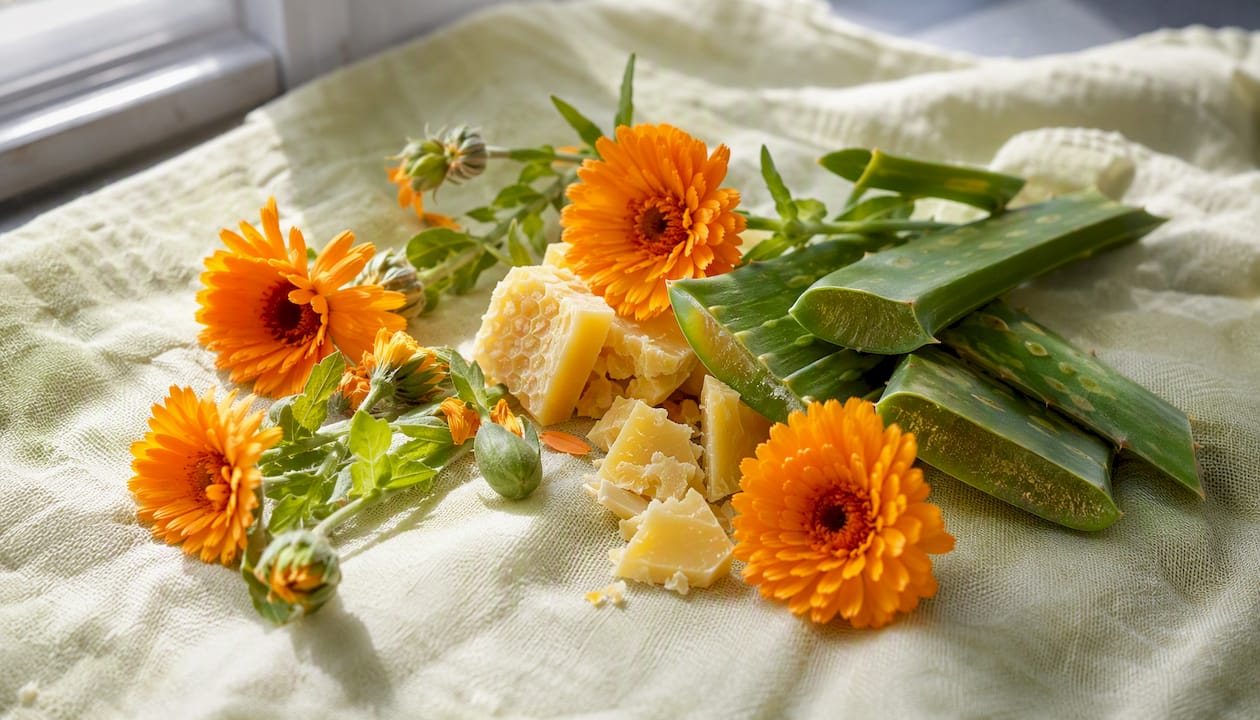
The difference between a balm that genuinely calms a bite and one that just smells nice comes down to what’s inside. Here’s what to look for — and what to watch out for.
Soothing botanicals and barrier agents
- Calendula — one of the most studied topical botanicals for skin inflammation; it calms redness and supports skin repair
- Willow bark — a natural source of salicylates, which have mild analgesic and anti-inflammatory properties; anti-inflammatory plant ingredients like these are well-documented in herbal medicine
- Helichrysum — prized for its skin-regenerating and anti-inflammatory properties; works well in low concentrations
- Aloe vera — cools on contact, reduces surface inflammation, and hydrates irritated skin
- Beeswax — the backbone of a solid balm; it forms a breathable barrier that locks in moisture and protects the bite from environmental irritants
- Tallow and shea butter — rich emollients that support the skin barrier without clogging pores
- Jojoba oil — structurally similar to the skin’s own sebum, so it absorbs well and carries other actives deeper into the skin
The AAD confirms that combining anti-inflammatory botanicals with barrier agents helps break the itch-scratch cycle — which is exactly what a well-formulated balm is designed to do.
Sensory ingredients and cautions
Some natural balms include low-percentage menthol blends for a cooling sensation, or lemongrass essential oil for its mild insect-deterrent properties. Both are effective in the right concentrations. The cautions:
- Essential oils and infants: the Cleveland Clinic advises that “natural” does not mean automatically safe for everyone — essential oils can cause reactions in infants and people with sensitive skin. Always patch test first.
- Menthol percentage: high menthol concentrations can irritate broken skin. Look for balms that list the percentage or keep menthol as a minor ingredient.
- “Fragrance” vs. “essential oil”: a label that says “fragrance” is hiding a proprietary blend that could contain dozens of synthetic compounds. A label that lists “lemongrass essential oil” or “lavender essential oil” tells you exactly what you’re getting.
What to scan on the label
- Full ingredient list (INCI names preferred)
- No vague “fragrance” entry
- Certifications: Non-GMO Project verification, organic where applicable
- Age guidance or warnings for children under 2
Pro Tip: To patch test, apply a small amount of balm to the inside of your wrist or elbow. Wait 24 hours. If you see redness, itching, or swelling at the test site, don’t use it on a bite — the inflamed skin around a bite is even more reactive than healthy skin.
How to treat a bug bite before and after applying balm
Clean first. That single step prevents more problems than any balm can fix after the fact. Cleaning any break in the skin with soap and water before applying treatments is the primary defense against secondary bacterial infection.
Here’s the full sequence:
- Move to safety — get away from the insect or nest to avoid additional stings
- Remove the stinger if present — scrape it sideways with a firm card or straight edge (a credit card works perfectly); never use tweezers, which can squeeze the venom sac and push more venom into the skin
- Wash with soap and water — clean the area thoroughly for at least 20 seconds
- Apply a cold compress — the CDC recommends an ice pack for 10 minutes to reduce swelling and numb the itch
- Apply your balm — once the skin is clean and dry, apply Jeffi Bug Bite Relief Balm directly to the bite; reapply per the directions on the label
- Resist scratching — the balm’s barrier layer is doing the work; let it
When to seek medical care: Go to an emergency room or call 911 if you notice difficulty breathing, swelling of the throat or tongue, a rapid heartbeat, dizziness, or a rash spreading far beyond the bite site. These are signs of anaphylaxis, a life-threatening allergic reaction. For less severe but worsening symptoms — increasing redness, spreading swelling, fever, or pain that doesn’t improve within a few days — Mayo Clinic recommends consulting a healthcare provider, as these may signal infection.
How to choose the right anti-itch balm for your needs
Not every balm fits every situation. Run through this checklist before you buy:
- ✅ Intended user — is it for an adult, a child, or an infant? Check age warnings carefully; many essential-oil-based formulas are not recommended for children under 2
- ✅ Form factor — do you need something portable for a hike, or a larger jar for the whole family at home?
- ✅ Key actives — look for anti-inflammatory botanicals (calendula, aloe, willow bark) AND a barrier agent (beeswax, shea) in the same formula
- ✅ Fragrance-free or essential-oil-based? — if you have sensitive skin, fragrance-free is safer; if you prefer a natural scent, verify the essential oils are listed by name with concentrations
- ✅ Certifications — Non-GMO Project verification is a meaningful third-party check; organic certification adds another layer
- ✅ Clear directions — a product with no usage instructions is a red flag
Questions to ask on the label or product page:
- Is it Non-GMO Project verified?
- Are essential oils listed with their common and/or Latin names?
- Is there a menthol percentage listed?
- Does it include an age warning?
Red flags to avoid: vague “fragrance” in the ingredient list, no directions for use, no ingredient list at all, or concentrations of skin-sensitizing botanicals with no guidance for sensitive skin.
Pro Tip: Price per ounce is a better comparison metric than sticker price. A $12 balm in a 0.5 oz stick costs more per use than a $20 jar with 2 oz of the same formula. Bundles often offer the best per-ounce value for families.
Stick, jar, or roll-on: which form fits your situation?
- Balm stick — clean, portable, and mess-free; ideal for tossing in a hiking pack, a beach bag, or a kid’s backpack. No fingers needed, which means less contamination of the product.
- Jar or tub — best for home use or family situations where you need a larger quantity. Lets you apply with a cotton swab for precision, or a fingertip for broader coverage.
- Roll-on — the no-touch option; great for applying to bites in awkward spots (behind the knee, on the ankle) without pressing directly on irritated skin. Also a smart pick for anyone who tends to scratch while applying.
- Ointment tube — direct, precise application; useful for a single isolated bite where you want to concentrate the formula without spreading it.
Jeffi offers both a balm/ointment and a roll-on format. The roll-on suits outdoor carry and on-the-go families; the balm/ointment is the go-to for home use and targeted relief. For travel, both formats are TSA-friendly at standard sizes.
Why natural balms work and what the safety evidence says
The science behind a well-made balm is straightforward. MedlinePlus confirms that most insect bites and stings can be managed at home with cold compresses, antihistamines, or topical creams — and that a balm fits naturally into that layered approach. The AAD’s guidance specifically supports barrier-forming products combined with anti-inflammatory botanicals to interrupt the itch-scratch cycle.
What the evidence also says clearly: “natural” is not a synonym for “risk-free.” The Cleveland Clinic notes that botanical ingredients can still trigger reactions, particularly in infants and people with sensitive skin. That’s why patch testing (see the pro tip in the ingredients section above) is a non-negotiable step before applying any new balm to an inflamed bite.
Signs that require medical evaluation — not more balm:
- Increasing redness or pain that spreads beyond the bite area
- Swelling that worsens after 24 hours
- Fever or chills
- Pus or discharge from the bite
- Difficulty breathing or swallowing (call 911 immediately)
A note on layering: Balms are part of a smart, layered approach to bite care — not a replacement for antihistamines or medical care when those are needed. Cold compress first, balm second, and oral antihistamine if the itch is systemic. That sequence covers most mild-to-moderate bites effectively.
Jeffi’s formulation philosophy
At Jeffi, every product starts with one question: would we put this on our own family’s skin? That standard drives the Non-GMO Project verification on our Bug Bite Relief Balm, the decision to list every ingredient transparently, and the choice to keep synthetic chemicals out of the formula entirely. Natural active botanicals like calendula and beeswax aren’t trend ingredients for us — they’re the foundation of a formula built to work gently and reliably.
Ready to try Jeffi Bug Bite Relief Balm?
Jeffi Bug Bite Relief Balm is the cleaner, greener alternative to synthetic itch creams — and it’s ready to ship directly to you.

Choose the format that fits your life:
- 🌿 Balm/Ointment — targeted relief at home; great for precise application on a single bite
- 🌿 Roll-On — no-touch, on-the-go convenience for outdoor adventures and travel
- 🌿 Bundles — the best per-ounce value for families who want both formats plus complementary skin care
High-quality all-natural bug bite balms typically run in a moderate price range depending on size and form. Jeffi’s bundle options offer the strongest value per ounce, especially for households that go through balm quickly during summer months. For a full look at the natural mosquito repellent and skin care line, visit Jeffi’s product pages and find the right fit for your family.
Sources
The medical and dermatology guidance throughout this article draws from these trusted sources. For severe reactions, always consult a healthcare professional rather than relying on home care alone.
- Insect bites and stings: First aid - Mayo Clinic
- Tips to prevent and treat bug bites - American Academy of Dermatology
- Bug bites & stings: Symptoms & treatment (First Aid) - Cleveland Clinic
- About mosquito bites - CDC
- Insect bites and stings: MedlinePlus Medical Encyclopedia
This article is for general informational purposes only and is not a substitute for professional medical advice. If you experience severe or worsening symptoms after a bite or sting, consult a qualified healthcare provider or seek emergency care.