

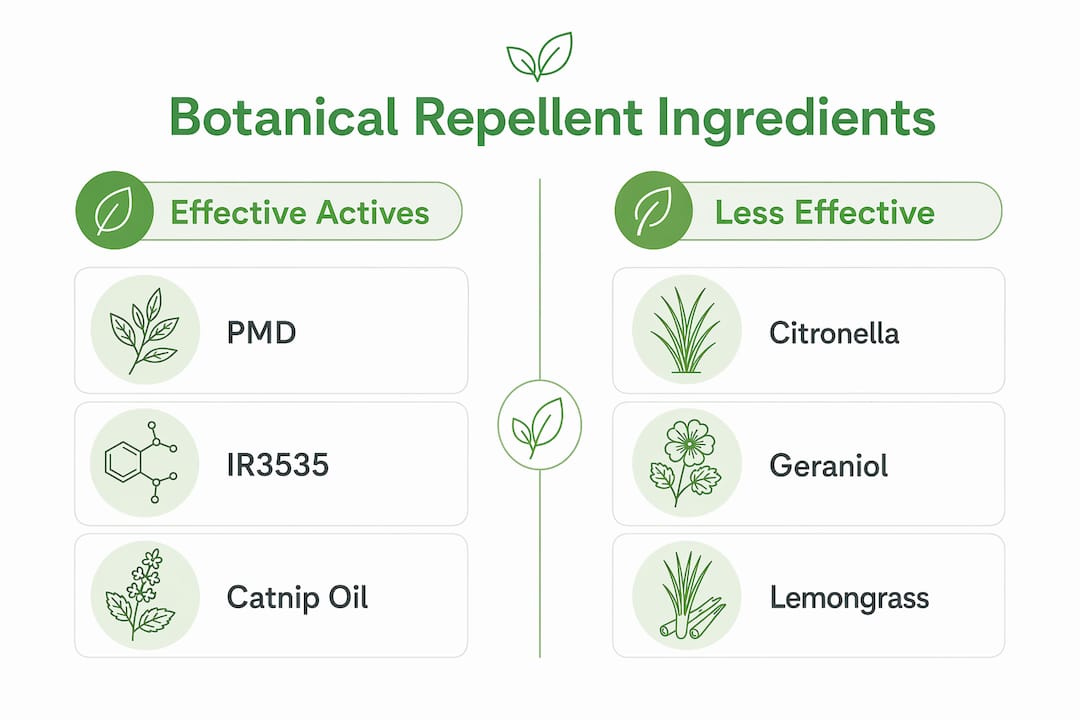
Yes, botanical insect repellents work — but how well depends almost entirely on which ingredient you choose and how the product is formulated. Para-menthane-3,8-diol (PMD), derived from the lemon eucalyptus tree (Corymbia citriodora), is the only plant-based active that the CDC endorses for use in disease-endemic settings, because it delivers multi-hour protection comparable to low concentrations of DEET. Most other botanical actives, including citronella, peppermint, and cedarwood, can reduce bites but typically wear off in 30 minutes to two hours. The peer-reviewed review by Maia & Moore (2011) remains the most comprehensive summary of plant-based repellent evidence, and it draws a clear line between PMD and everything else.
Here is the short version of what that means for you:
- For backyard evenings, picnics, or short outdoor windows: a well-formulated botanical bug spray or balm is a reasonable, pleasant choice.
- ✅ For travel to malaria or dengue regions, or multi-hour exposure in high West Nile activity areas: use an EPA-registered active (DEET, picaridin) or a PMD-based product per CDC guidance.
- Reapplication is non-negotiable: even the best botanical repellent needs reapplication every one to two hours in warm, humid conditions.
Read on for the full evidence breakdown, a formulation guide, and a practical checklist for choosing the right product.
Table of Contents
- What does the evidence say about botanical repellent ingredients?
- How formulation changes how long your repellent actually lasts
- How do botanical repellents compare to DEET and picaridin?
- How to choose a safe, effective botanical repellent
- Is “natural” always safe? Myths and real safety concerns
- Why PMD stands out: what the research actually says
- Key Takeaways
- Jeffi’s take on what actually matters in a botanical repellent
- Jeffi’s DEET-free botanical repellents, ready to use
- Further reading and primary sources
What does the evidence say about botanical repellent ingredients?
Not all plant-based actives are created equal. The table below summarizes the most studied botanical ingredients, their typical protection windows, and the quality of evidence behind them.

| Ingredient | Plant Source | Typical Protection Window | Evidence Quality |
|---|---|---|---|
| PMD (para-menthane-3,8-diol) | Lemon eucalyptus (Corymbia citriodora) | multi-hour | Field + human lab; CDC-endorsed |
| Citronella | Cymbopogon grasses | short period | Human lab; limited field data |
| Patchouli | Pogostemon cablin | limited duration in lotion base | Controlled lab (lotion formulation) |
| Thyme oil | Thymus vulgaris | short period | Lab studies |
| Geraniol | Geranium / palmarosa | short period | Lab + limited human studies |
| Peppermint | Mentha piperita | short period | Lab studies |
| Cedarwood | Cedrus spp. | short period | Lab studies |
| Clove | Syzygium aromaticum | short period | Lab studies |
| Neem | Azadirachta indica | varied duration | Field + lab (varies by formulation) |
PMD’s advantage comes down to chemistry. Most essential oils are volatile monoterpenes, meaning they evaporate quickly off skin, especially in heat. PMD has a lower vapor pressure, so it stays on the skin longer and maintains an effective concentration around you. That physical property is why PMD provides multi-hour protection while citronella fades in under two hours under the same conditions.
** Statistic callout:** A controlled laboratory study found that patchouli oil formulated into an unscented lotion provided protection comparable to DEET, with no bites recorded on treated arms during the trial period. The key variable was the lotion base, not the oil alone.
Citronella is the most familiar name in natural insect repellent, and it does work — just not for long. Under ideal conditions (low heat, low humidity, no wind), you might get close to two hours. In a hot backyard in July, expect closer to 30–45 minutes before you need to reapply. Neem is worth noting because it has both lab and some field data, and it works through a slightly different mechanism (disrupting insect feeding behavior), which gives it a broader spectrum of activity against ticks and flies, not just mosquitoes.
How formulation changes how long your repellent actually lasts
The oil in a botanical repellent is only half the story. How that oil is delivered to your skin, and how it stays there, often matters more than the oil itself.

Plain sprays disperse volatile oils quickly. A lotion, balm, or cream base slows that evaporation by embedding the active in a higher-molecular-weight carrier. Glycerol matrices, wax-based balms, and microencapsulation techniques all work on the same principle: they create a slow-release reservoir that keeps the active ingredient at an effective concentration on your skin for longer. Vanillin added as a stabilizer has been shown in lab settings to extend the protection time of several botanical actives, including citronella.
Formulation formats at a glance:
- Sprays: Easy to apply, good for large areas, but volatile oils evaporate faster. Best for short outdoor windows or when convenience matters most.
- Lotions and creams: Slow evaporation, better skin contact, and often more moisturizing. The lotion base is one of the most practical ways to extend a botanical active’s wear time.
- Balms and ointments: Wax or butter carriers provide the slowest release. Ideal for targeted areas like wrists, ankles, and the back of the neck. Jeffi’s balm-format repellents use this principle.
- Roll-ons: Precise application, less waste, and good for face-adjacent areas. Protection time depends on the carrier, not the format.
- Treated fabrics / clothing: Permethrin is the standard here (a synthetic), but some botanical-treated fabrics exist. Useful as a complement, not a standalone.
- Microencapsulated or nanoemulsion formulations: The most advanced delivery systems; lab data shows prolonged repellency, though fewer consumer products use them yet. Worth looking for on labels.
Pro Tip: When shopping for a botanical repellent, look for words like “slow-release,” “microencapsulated,” “lotion base,” “vanillin,” or “glycerol” in the ingredient list. These signal that the manufacturer has thought about delivery, not just the active ingredient.
How to apply for full coverage:
- Apply to all exposed skin before going outside, not after you notice the first bite.
- Use enough product. A thin mist is not sufficient. For a lotion or balm, rub a visible layer into the skin until absorbed.
- For face application: apply to your hands first, then rub onto your face, avoiding eyes and mouth.
- Don’t skip the wrists, ankles, and the back of the neck. These are the most common bite sites and the most commonly missed spots.
- Reapply every 1–2 hours in warm or humid conditions, or immediately after swimming or heavy sweating. Treat label reapplication guidance as a minimum, not a maximum.
How do botanical repellents compare to DEET and picaridin?
Synthetics generally win on duration and predictability. DEET at 20–30% concentration typically provides 4–8 hours of protection; picaridin at similar concentrations performs comparably and tends to feel lighter on skin. PMD is the best plant-based bridge between the two worlds, offering multi-hour protection with a natural origin story.
Side-by-side comparison:
- DEET (20–30%): 4–8 hours protection, broad-spectrum, EPA-registered, slight odor, can damage some plastics and synthetic fabrics. Safe for adults and children over 2 months per CDC guidance.
- Picaridin (20%): 4–8 hours, odorless, does not damage fabrics, well-tolerated on skin. Increasingly the preferred synthetic for sensitive users.
- PMD (lemon eucalyptus): 4–6 hours, plant-derived, CDC-endorsed for disease settings, mild pleasant scent. Not recommended for children under 3.
- Citronella / essential oil blends: 30 min–2 hours, pleasant scent, low irritation risk when diluted, not recommended for disease-endemic travel. Best for nuisance repellency.
- Neem-based formulas: 1–3 hours, broader insect spectrum, earthy scent, some field data. A reasonable choice for gardening or yard use.
The risk-based decision rule is simple: if you are traveling to an area with active malaria, dengue, Zika, or West Nile virus transmission, use an EPA-registered active or a PMD product. For a backyard cookout, a short trail walk, or a camping trip in a low-risk area, a well-formulated herbal insect deterrent is a perfectly sensible choice.
Two quick scenarios:
Backyard picnic on a summer evening: A citronella or geraniol balm applied 15 minutes before guests arrive, reapplied at the two-hour mark, gives comfortable protection with no chemical odor and no skin-feel complaints.
Four-hour forest hike during peak West Nile season: This is not the moment for a plant-based bug spray alone. Use picaridin or DEET, or at minimum a PMD-based product, and treat your clothing with permethrin for tick coverage.
How to choose a safe, effective botanical repellent
Choosing the right plant-based bug spray comes down to reading the label carefully and knowing what to look for. Here is a practical checklist:
- Check the active ingredient first. If you need longer protection or are in a higher-risk setting, look for PMD (para-menthane-3,8-diol) or “oil of lemon eucalyptus” listed as the active. For nuisance repellency, citronella, geraniol, or neem are reasonable choices.
- Prefer a lotion, balm, or cream base. These slow evaporation and extend wear time compared to plain sprays. Look for glycerol, wax, shea butter, or microencapsulation in the ingredient list.
- Check concentration and reapplication guidance. A product that lists an active but gives no reapplication schedule is a red flag. Effective products tell you exactly how often to reapply.
- Confirm age and pregnancy warnings. PMD and lemon eucalyptus products are not recommended for children under 3. Many essential oil blends carry their own age cautions. If you are pregnant, consult your healthcare provider before using any repellent.
- Look for third-party certifications if they matter to you. Non-GMO Project verification, cruelty-free certification, and USDA organic labeling all indicate a level of ingredient scrutiny that generic “natural” claims do not.
Red flags to avoid:
- “Natural” or “plant-based” on the label with no active ingredient named
- “Up to X hours” protection claims with no reference to test conditions or reapplication guidance
- No dilution or age warning for essential-oil-based products
- DIY recipes from social media with no standardized concentration guidance
Label-reading tip: “Plant-based active” is a marketing phrase, not a regulatory category. The meaningful term is the actual ingredient name. “Oil of lemon eucalyptus” is an EPA-registered active when it refers to the refined PMD extract. “Lemon eucalyptus essential oil” is not the same thing and does not carry the same evidence. That distinction matters when you are comparing products on a store shelf.
Is “natural” always safe? Myths and real safety concerns
“Natural” does not mean automatically safe, and this is probably the most important thing to understand before you buy or mix any botanical repellent. Essential oils are bioactive compounds. They can irritate skin, trigger allergic reactions, and in some cases be toxic if misused.
Common myths vs. facts:
-
❌ Myth: Natural repellents are safe for everyone, including infants. ✅ Fact: Many essential oils are contraindicated for children under 2, and PMD/lemon eucalyptus products are not recommended under age 3. Always check the label.
-
❌ Myth: Citronella candles protect you all evening. ✅ Fact: Candles create a very localized, low-concentration vapor. They reduce bites in a small radius but do not replace skin-applied repellent.
-
❌ Myth: You can apply undiluted essential oils directly to skin. ✅ Fact: Undiluted oils can cause chemical burns and sensitization. Always dilute in a carrier oil or use a formulated product.
-
❌ Myth: DIY recipes are just as effective as commercial products. ✅ Fact: Homemade repellents using witch hazel or vinegar bases can provide short-term relief, but they lack standardized testing and consistent concentration control.
Safety checklist before you use any botanical repellent:
- Patch test first. Apply a small amount to the inside of your wrist and wait 24 hours before broad use, especially with a new product or essential oil blend.
- Dilute properly. For DIY blends, a 1–2% dilution (roughly 6–12 drops of essential oil per ounce of carrier) is a safe starting point for adults.
- Keep away from children’s hands. Kids touch their faces constantly. Apply repellent to their clothing and exposed skin yourself, and avoid their hands.
- Pregnancy caution. Several essential oils, including clove and thyme at high concentrations, are not recommended during pregnancy. PMD products also carry a pregnancy caution on most labels. Consult your OB or midwife.
- Pet safety. Cats are particularly sensitive to essential oils, especially tea tree, eucalyptus, and peppermint. Keep pets away from treated skin until the product has fully absorbed, and never apply botanical repellents directly to animals unless the product is specifically formulated for them.
- Seek medical help if you experience redness, swelling, difficulty breathing, or hives after applying any repellent.
On environmental impact: most botanical actives biodegrade faster than synthetic repellents like DEET, which has been detected in waterways. That said, the full environmental picture includes packaging, surfactants, and preservatives. An eco-friendly bug spray should be evaluated on the whole formulation, not just the active ingredient.
Pro Tip: If you are buying a botanical repellent for a child, look for products that specifically list the child’s age range on the label and carry a third-party certification. A Non-GMO Project verified seal, for example, signals that the ingredient sourcing has been independently reviewed.
Why PMD stands out: what the research actually says
The scientific case for PMD is stronger than for any other plant-based repellent active, and understanding why helps you make smarter choices across the whole category.
The Maia & Moore (2011) peer-reviewed review in Malaria Journal is the most-cited summary of plant-based repellent evidence. Its core finding: most botanical actives have been tested only in laboratory settings, often under conditions that do not reflect real-world use. Many lack adherence to the WHO Pesticide Evaluation Scheme, which means their efficacy data cannot be directly compared to registered synthetics. PMD is the exception. It has field trial data against malaria vectors, and its lower vapor pressure means it maintains an effective skin concentration for several hours rather than minutes.
Entomologists also point to a practical reality that lab studies often understate: heat, humidity, and airflow dramatically shorten the protection window of volatile oils in the field. A citronella product that lasts 90 minutes in a climate-controlled lab might give you 30 minutes on a humid August afternoon with a breeze. This is not a flaw in the research; it is a reminder that label claims are generated under controlled conditions.
What this means for everyday use:
- Expect shorter protection windows outdoors than the label suggests in warm or windy conditions.
- Choose stabilized formulations (lotion, balm, vanillin-added) to get closer to the label’s stated duration.
- Reapply on a schedule, not when you notice bites. By the time you feel a bite, the protection window has already closed.
- For disease prevention, only PMD among plant-based options has the evidence base to justify reliance in higher-risk settings.
The regulatory picture reinforces this. The EPA’s minimum-risk pesticide exemption covers many essential oils, which means they can be sold without full registration testing. That is convenient for manufacturers but means the burden of evaluating evidence falls on you as the buyer.
Key Takeaways
PMD (para-menthane-3,8-diol) is the only plant-based repellent active with CDC-endorsed field efficacy; all other botanicals work best for short-duration, low-risk outdoor use in a well-formulated lotion or balm base.
| Point | Details |
|---|---|
| PMD is the standout botanical | Only plant-based active CDC endorses for disease settings; provides multi-hour protection. |
| Formulation extends wear time | Lotion, balm, and slow-release carriers keep volatile oils active longer than plain sprays. |
| Reapply every 1–2 hours | Treat label guidance as a minimum; heat and humidity shorten real-world protection windows. |
| “Natural” ≠ automatically safe | Essential oils require dilution, patch testing, and age/pregnancy checks before use. |
| Jeffi’s botanical balms | DEET-free, Non-GMO Project verified formulations designed for nuisance protection and sensitive skin. |
Jeffi’s take on what actually matters in a botanical repellent
There is a version of this conversation that never gets past “citronella is natural and DEET is scary,” and it does not serve anyone well. The honest picture is more interesting: plant-based repellents have real, documented efficacy for a specific range of use cases, and the gap between a well-formulated botanical product and a poorly formulated one is enormous.
What gets underestimated most often is the formulation side. Consumers spend a lot of energy evaluating the active ingredient on the label and almost none evaluating the carrier. A citronella spray in a water-alcohol base will fade in 30 minutes on a warm day. The same citronella concentration in a wax-based balm with a glycerol matrix might give you 90 minutes. That difference is entirely in the delivery system, not the oil. The patchouli lotion study is a useful illustration: the oil was not new, but the formulation unlocked performance that a plain spray would never have achieved.
The other underestimated factor is coverage. Most people apply repellent the way they apply sunscreen on a rushed morning: a quick pass, a few missed spots, and then surprise when the mosquitoes find the one uncovered ankle. Consistent, complete coverage matters more than which oil is in the bottle.
At Jeffi, the product design philosophy starts with those two realities: choose actives with real evidence behind them, and build the formulation to keep those actives working. Non-GMO Project verification is part of that commitment to ingredient transparency. So is clear application guidance on every product. You should know exactly what you are putting on your skin, why it works, and when to reapply. That is not a complicated ask, and it is the baseline any botanical repellent worth buying should meet.
Jeffi’s DEET-free botanical repellents, ready to use
If you have read this far, you already know what to look for: a named active ingredient, a lotion or balm base that slows evaporation, clear reapplication guidance, and third-party certification that the ingredients are what the label says they are.

Jeffi’s DEET-free mosquito repellent balms and roll-ons are built around exactly those priorities. Every product is Non-GMO Project verified, free from synthetic pesticides, and formulated in a skin-care-grade base that keeps the botanical actives working longer than a plain spray would. They are designed for people who spend real time outdoors — families, hikers, gardeners, anyone who wants effective nuisance protection without the chemical feel of conventional repellents. The same gentle formulation philosophy carries through to Jeffi’s bug bite relief lotions and skin care line, so you can treat a bite as naturally as you prevented it.
Ready to find the right formula for your outdoor routine? Browse Jeffi’s full range of natural mosquito repellents and check the product pages for full ingredient lists, application guidance, and safety information. If you have questions about which product fits your situation, the mosquito repellent FAQ is a good starting point.
Further reading and primary sources
These are the highest-value sources cited in this article. Each one is linked where the relevant claim appears in the body above.
-
Maia & Moore (2011), Malaria Journal — PMC full text: The most comprehensive peer-reviewed review of plant-based repellent efficacy. Covers PMD field data, volatility chemistry, WHO testing gaps, and ethnobotanical discovery paths. The primary source for the PMD evidence claims throughout this article.
-
Medical News Today — Natural insect repellents: 10 options: Accessible summary of essential oil efficacy ranges, environmental factors that shorten protection, and safety guidance for children and pets. Used for realistic protection-time ranges and field-condition caveats.
-
Outside Online — Patchouli lotion study coverage: Reports on the controlled lab study finding patchouli oil in a lotion base matched DEET performance. Also covers dermatologist and entomologist guidance on dilution and patch testing.
-
The Old Farmer’s Almanac — Homemade bug spray recipes: Practical DIY recipes using witch hazel and essential oils, with honest notes on skin irritation risks and pet safety. Cited in the safety section for DIY tradeoffs.
-
EPA eCFR — 40 CFR § 152.25, minimum-risk pesticide exemptions: The regulatory basis for why many essential-oil repellents can be sold without full EPA registration. Cited in the label-reading section.
-
Bass Angler Magazine — Natural insect repellent patch: Covers alternative delivery formats and user safety considerations for botanical repellents in outdoor recreation contexts.